In the commercial building and renovation sectors, surface material selection directly impacts project longevity, life-cycle costs, and overall asset value. Architecture firms, general contractors, and bulk flooring distributors increasingly specify rigid core synthetic surfaces over traditional hardwood or ceramic tile. Identifying the best rated luxury vinyl plank flooring requires a rigorous examination of physical properties, manufacturing standards, and structural composition rather than relying solely on surface aesthetics.
Modern resilient flooring has evolved significantly beyond early generation sheet vinyl. Today, high-density Stone Plastic Composite (SPC) and premium Flexible Luxury Vinyl Tile (LVT) represent the gold standard for high-traffic environments. This article outlines the structural parameters, laboratory testing benchmarks, and operational factors that procurement professionals must evaluate when specifying large-scale commercial installations.
Structural Anatomy of Commercial-Grade Luxury Vinyl Planks
To understand why a product achieves top-tier performance ratings, specifiers must evaluate each layer within the plank's cross-section. The mechanical integrity of luxury vinyl plank (LVP) relies on a precise multi-layer lamination process.
Polyurethane Surface Treatment: The topmost layer features a factory-applied, UV-cured polyurethane coating, frequently reinforced with microscopic aluminum oxide or ceramic beads. This coating acts as the primary defense against micro-scratching, chemical staining, and UV degradation.
Commercial Wear Layer: Situated directly beneath the surface finish, this clear PVC layer determines the product's wear resistance class. For heavy commercial applications, a minimum wear layer thickness of 0.50 mm (20 mil) or 0.70 mm (28 mil) is mandatory.
High-Definition Photographic Film: Utilizing advanced rotogravure or direct digital printing, this layer provides visual authenticity, mimicking natural timber species, stone textures, or concrete finishes.
Rigid Core Board (SPC): Formulated from an optimized ratio of natural limestone powder (calcium carbonate), polyvinyl chloride resin, and non-toxic stabilizers. High-quality SPC cores feature a density ranging between 1,900 kg/m³ and 2,100 kg/m³, offering exceptional dimensional stability and impact resistance.
Integrated Acoustic Underlayment: Factory-attached backing materials—such as high-density Cross-Linked Polyethylene (IXPE) or Ethylene-Vinyl Acetate (EVA)—provide sound attenuation and compensate for minor subfloor irregularities.
Key Performance Indicators for Commercial Specifiers
When selecting the best rated luxury vinyl plank flooring for heavy-traffic commercial zones, static data sheets must be verified against standardized international testing protocols.
1. Dimensional Stability and Thermal Expansion
Commercial structures experience fluctuating indoor temperatures and humidity levels. Unstable materials expand or contract, leading to edge peaking, gapping, or joint disengagement. Standard testing under ASTM F2199 requires boards to maintain structural dimensional changes below 0.10% after thermal exposure. High-density SPC formulations mitigate expansion issues, remaining dimensionally stable across wide temperature variations.
2. Wear Layer Thickness and Abrasion Resistance
Wear layer thickness directly correlates with commercial service life. While residential projects typically utilize 0.30 mm (12 mil) wear layers, commercial environments demand higher performance. The Taber Abraser Test (EN 660-2) measures the volume loss of the surface layer under continuous abrasive wheel friction. Products qualifying for Group T wear ratings demonstrate maximum abrasion resistance, making them ideal for healthcare corridors, education facilities, and retail spaces.
3. Static Load Limit and Residual Indentation
Heavy furniture, rolling hospital beds, and pallet jacks exert concentrated static loads. Under ASTM F970, the best rated luxury vinyl plank flooring exhibits residual indentation of less than 0.005 inches after experiencing static loads exceeding 1,500 pounds per square inch (psi). High calcium carbonate content within the SPC core prevents permanent compression marks, preserving floor flatness over decades of heavy use.
Evaluating Surface Textures: Standard Embossing vs. EIR
Visual and tactile realism are key purchasing drivers for hospitality and multi-family residential developments. Manufacturing techniques dictate the fidelity of the finished plank surface.
Standard surface finishing applies a generic texture across the wear layer, providing basic slip resistance without matching the underlying printed visual. In contrast, Embossed in Register (EIR) technology utilizes synchronized steel rollers to align the surface texture precisely with the wood grain image beneath. EIR not only elevates aesthetic value but also increases natural slip resistance (achieving R10 or R11 ratings under DIN 51130 protocols) without relying on aggressive surface additives that trap dirt.
Manufacturing facilities operated by TAB Flooring integrate multi-stage laser alignment during the pressing process. This ensures that EIR registration tolerances stay within 0.2 mm across large production runs, preventing pattern alignment drift during extensive site installations.
Click-Lock Engineering and Installation Efficiency
Labor costs represent a major portion of overall flooring replacement budgets. The mechanical profiling of the plank edges dictates both installation speed and long-term seam integrity.
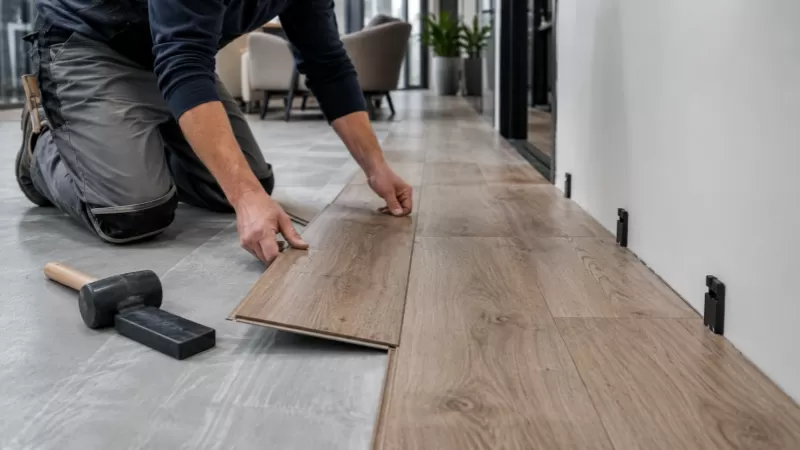
Angle-Angle Locking Profiles: Require the installer to insert the tongue into the groove at an angle before lowering the plank flat. This offers superior tensile strength along the long joint edge.
Drop-Lock / Push-Down Systems: Utilize an integrated side clip mechanism for the short ends, allowing rapid drop-down installation. This setup increases installation speed by up to 30% compared to traditional glueless systems.
Direct Glue-Down (Dryback): Preferred in high-traffic commercial installations with continuous rolling loads. While lacking mechanical click joints, glue-down LVT eliminates air gaps and maximizes acoustic dampening directly against concrete subfloors.
Precision milling is crucial for click systems. Sub-millimeter deviations in joint profiles cause vertical unevenness (lippage), which accelerates edge chipping under heavy foot traffic. Strict quality control during profiling helps ensure seamless joint engagement.
Acoustic Control Metrics in Multi-Family and Commercial Buildings
Impact sound transmission between floors remains a frequent source of tenant dissatisfaction in multi-family housing, hotels, and corporate offices. Building codes globally enforce strict acoustic standards measured via Impact Insulation Class (IIC) and Sound Transmission Class (STC) testing under ASTM E492 and ASTM E90 standards.
Bare concrete slabs typically deliver poor IIC ratings (around 28-35 dB). Installing best rated luxury vinyl plank flooring equipped with a high-density 1.5 mm IXPE underlayment elevates the assembly performance to IIC 55 dB or higher, significantly dampening footfall sound transmission. TAB Flooring incorporates closed-cell acoustic foam backings engineered to maintain structural memory, preventing cell collapse under long-term dynamic loading.
Chemical Composition, Indoor Air Quality, and Sustainability
Global environmental regulations require architectural materials to comply with strict chemical emission thresholds. Sourcing decisions must account for raw material purity and indoor air quality certifications.
Virgin PVC resin offers predictable structural strength and uniform chemical properties. Recycled post-industrial content reduces environmental impact, but recycled streams containing trace heavy metals or inconsistent plasticizer concentrations can compromise dimensional stability and cause off-gassing. Specifiers should demand third-party environmental certifications, such as FloorScore or GREENGUARD Gold, ensuring total Volatile Organic Compound (VOC) emissions remain below strict parts-per-billion (ppb) limits.
Furthermore, phthalate-free plasticizer technology is now mandatory across modern procurement frameworks. Sourcing 100% phthalate-free SPC flooring ensures compliance with international building standards and supports healthier indoor spaces.
Commercial Sourcing Matrix: SPC vs. Dryback LVT vs. WPC
Determining the right substrate format depends heavily on specific site conditions and budget parameters. The table below outlines key engineering differences among core resilient flooring categories:
| Property / Specification | Rigid Core SPC | Dryback Commercial LVT | Wood Plastic Composite (WPC) |
|---|---|---|---|
| Core Density | Very High (1,900 - 2,100 kg/m³) | Medium (1,300 - 1,400 kg/m³) | Moderate (900 - 1,050 kg/m³) |
| Impact Resistance | Exceptional (Resists heavy drop impacts) | Moderate (Dependent on subfloor) | Moderate to High |
| Subfloor Imperfection Tolerance | High (Bridges minor telegraphing) | Low (Subfloor defects telegraph) | High |
| Thermal Stability | Superior (Minimal expansion) | Moderate | Moderate |
| Primary Application | High-Traffic Commercial, Multi-Family | Healthcare, Supermarkets, Education | Residential, Low-Traffic Commercial |
Quality Control and Factory-Level Auditing Parameters
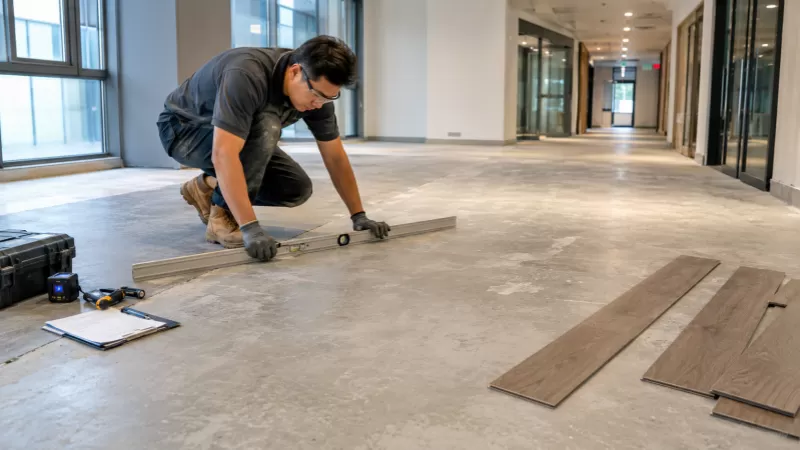
For large-scale importers and procurement heads, evaluating sample boards is insufficient. Bulk production consistency requires strict control across manufacturing stages.
During extrusion, temperature management across the multi-zone die must stay within tight limits. Temperature fluctuations alter resin viscosity, resulting in variable plank thickness and density gradients across the master sheet. Annealing tanks are necessary to relieve internal stresses within extruded sheets before lamination. Skipping or rushing the annealing process increases internal stress, causing boards to warp post-installation when exposed to sunlight.
Direct supply partners like TAB Flooring utilize automated optical inspection systems on production lines to check for microscopic print errors, debris under the wear layer, and micro-bevel defects before final packaging. This ensures low defect rates across container-shipment orders.
Optimizing Bulk Supply Chain and Sourcing Logistics
Managing supply chain logistics for heavy building materials requires careful planning regarding container load factors, packaging integrity, and transit conditions.
Because SPC flooring features high density, shipping container limits are typically reached by weight before volume limits are met. Standard 20-foot heavy-duty ocean containers accommodate roughly 2,100 to 2,400 square meters of 4.0 mm SPC flooring without exceeding axle weight limits. Packaging must utilize reinforced wooden pallets with corner protectors and shrink-wrapping to resist humidity shifts and ocean transit motion, delivering factory-fresh materials directly to job sites.
Carefully evaluating physical properties, wear resistance specs, and factory quality processes allows procurement managers to secure best rated luxury vinyl plank flooring that delivers long-term durability, structural integrity, and superior visual appeal for demanding commercial spaces.
Frequently Asked Questions
Q1: What wear layer thickness is required for heavy commercial
flooring projects?
A1: For high-traffic commercial environments,
such as retail stores, healthcare facilities, and educational institutions, a
minimum wear layer thickness of 0.50 mm (20 mil) is recommended. Highly
demanding zones benefit from a 0.70 mm (28 mil) wear layer paired with a
ceramic-bead UV surface treatment to ensure long-term durability.
Q2: How does SPC flooring differ from traditional flexible LVT in
commercial applications?
A2: SPC features a rigid core composed of
natural limestone powder and PVC resin, resulting in a core density exceeding
1,900 kg/m³. This rigidity prevents minor subfloor imperfections from showing
through on the surface (telegraphing) and offers superior impact resistance
compared to flexible, glue-down LVT.
Q3: Why is Embossed in Register (EIR) surface finish preferred in
modern project specifications?
A3: EIR technology synchronizes the
physical surface texture directly with the underlying high-definition printed
grain pattern. This creates a realistic wood or stone appearance while improving
slip resistance (R10/R11 ratings) without creating rough surface pockets that
collect dirt.
Q4: What acoustic ratings should be specified for multi-family
residential developments?
A4: Multi-family projects typically
require Impact Insulation Class (IIC) and Sound Transmission Class (STC) ratings
of 50 dB or higher. Specifying luxury vinyl plank with a factory-attached 1.5 mm
IXPE acoustic backing helps floor assemblies meet or exceed these regulatory
noise control standards.
Q5: How can procurement officers ensure bulk shipments maintain
consistent color matching across batches?
A5: Importers should
require factories to track color consistency using spectrophotometers, keeping
color variance within a Delta E value under 0.5. Working with established
manufacturers that produce custom orders in single continuous extrusion runs
minimizes batch-to-batch visual variations.
Request Custom OEM/ODM Quotations and Technical Samples
Procuring high-performance resilient flooring for large-scale developments requires dependable manufacturing standards, custom design capabilities, and complete technical compliance. TAB Flooring specializes in custom OEM and ODM manufacturing of rigid core SPC and commercial LVT tailored to your project requirements.
Contact our B2B project engineering team today to request physical sample kits, full technical data sheets (TDS), or a factory-direct wholesale quotation for your upcoming commercial supply contracts.