Flooring professionals often repeat an old industry rule: floors are thirty percent product and seventy percent installation. Even the most durable stone plastic composite floor fails to impress if the transitions clash or pull loose after three months. For building material distributors and brand owners, accessory defects trigger costly warranty claims.
Sourcing high-grade SPC flooring accessories directly from an experienced OEM manufacturer protects your profit margins. Instead of dealing with five separate suppliers for trims, underlayment, and planks, smart importers consolidate production. Sourcing everything under one roof streamlines quality control, guarantees color alignment, and simplifies container logistics.
At TAB Flooring, we engineer floor systems and compatible trims for international distributors. If you want to expand your current line or solve persistent color variation between planks and trims, reach out to our engineering team today for technical drawings and custom quotes.
Custom Profiles: Beyond the Standard Transitions
Every architectural project brings unique floor heights, subfloor conditions, and threshold demands. Supplying generic trim shapes limits your market appeal. Modern OEM production allows brands to order exact geometries tailored to specific click systems and core thicknesses.
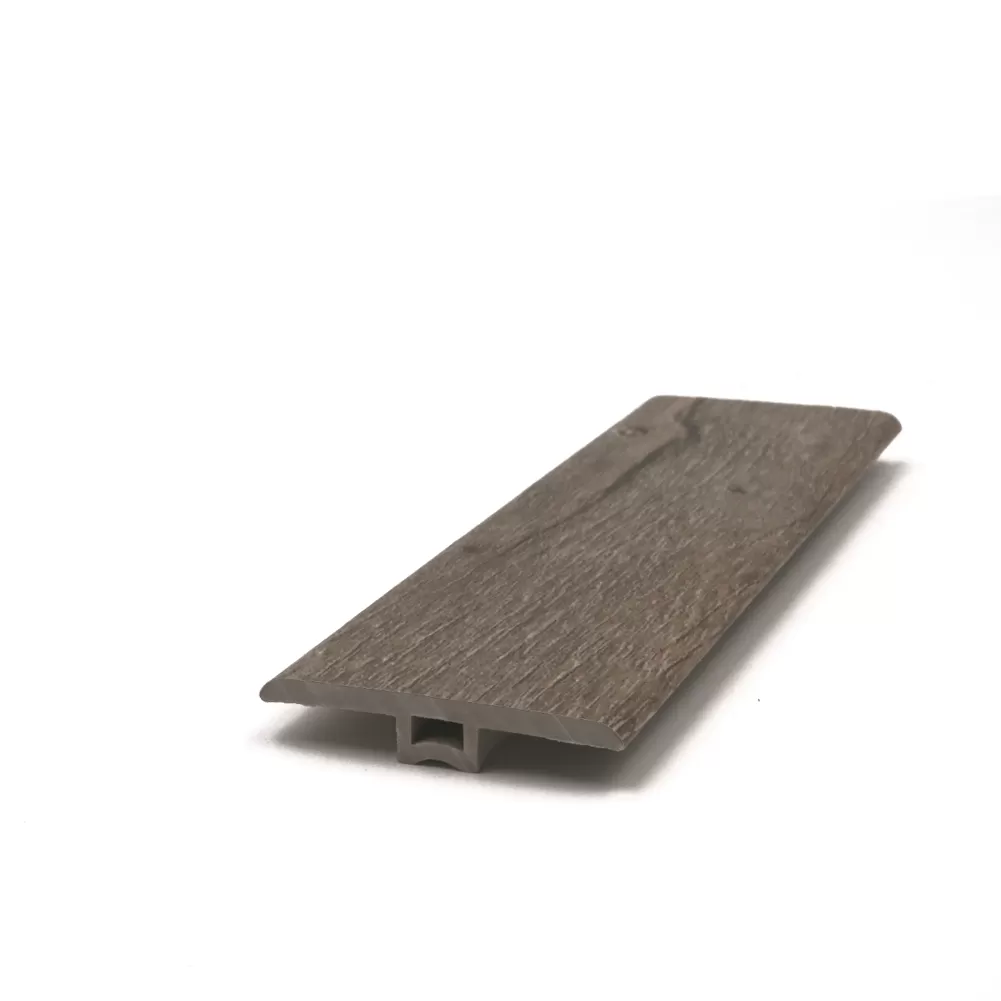
1. T-Molding for Same-Level Expansions
Rigid core vinyl still expands and contracts across long runs. T-moldings provide the necessary expansion space between rooms with identical floor heights. A balanced profile design ensures the trim covers the gap without creating a tripping ledge.
2. Reducer for Uneven Surfaces
Connecting rigid SPC to low-pile carpet, sheet vinyl, or bare concrete requires a clean incline. Custom reducers offer subtle slopes that accommodate height drops from 2mm up to 8mm, maintaining ADA compliance and smooth foot traffic.
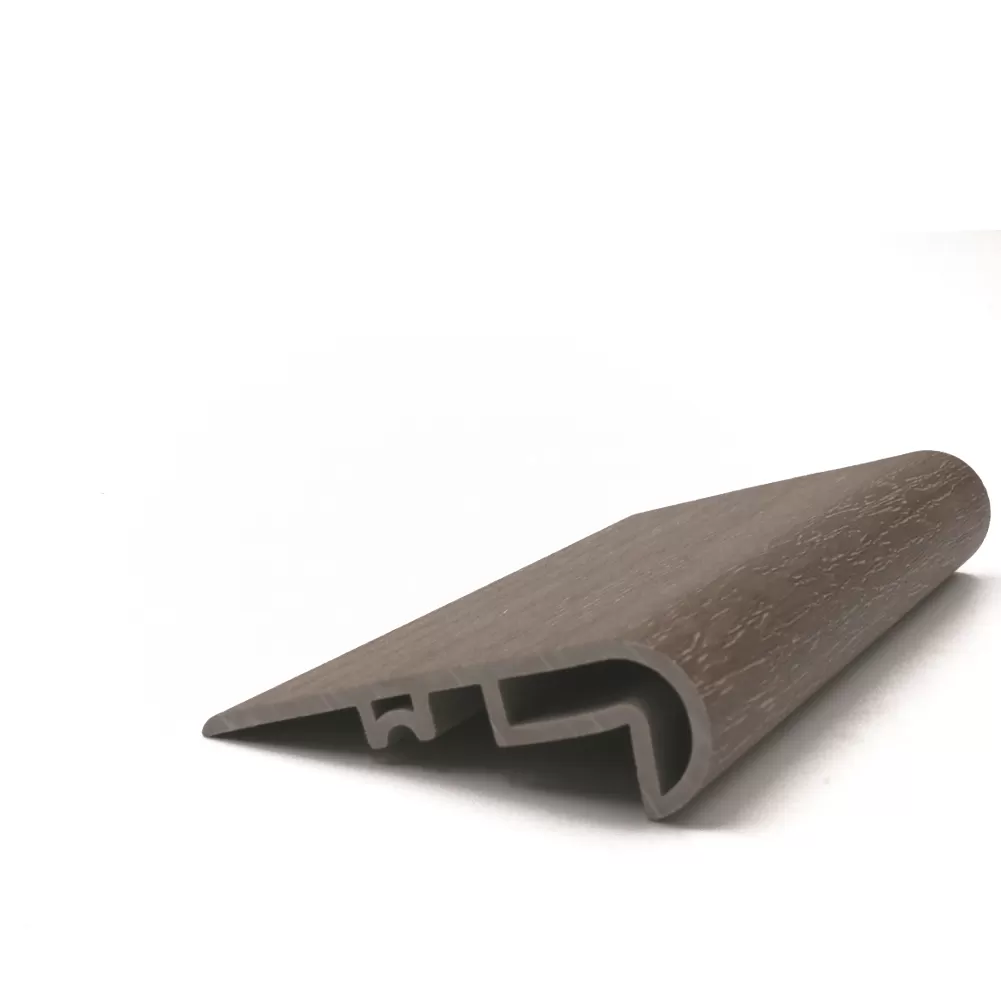
3. SPC Stair Nose: Flush vs. Overlap
Stairs present the highest safety risk in any building. OEM buyers can select between two primary stair nose architectures:
- Flush Stair Nose: Integrates directly into the plank's click lock. It sits completely level with the step, delivering a modern, built-in appearance favored in high-end residential jobs.
- Overlap Stair Nose: Sits over the edge of the step. It allows wider expansion gaps and handles subfloor irregularities better during fast commercial installations.
Both profile styles should feature micro-grooves or slip-resistant wear layers to meet regional safety codes.
4. End-Cap / Square Nose
End-caps terminate flooring runs against vertical obstructions such as sliding glass door tracks, fireplace hearths, and exterior thresholds. A well-designed square nose grips the plank firmly while hiding the cut edge completely.
5. Quarter Round and Skirting
While baseboards run along walls, quarter rounds offer a flexible way to mask perimeter gaps without removing existing woodwork. Water-resistant SPC quarter rounds have replaced painted MDF in moisture-heavy zones like bathrooms and laundry rooms.
Tooling, Extrusion, and Click Compatibility
Generic trims frequently snap loose because their under-groove does not match the floor core thickness. Reliable OEM factories develop custom extrusion dies based on your technical CAD files. Maintaining tight machining tolerances ensures vinyl flooring transitions lock firmly into track systems or glue down cleanly on concrete screed.
Mastering Color and Texture Matching
The single biggest headache for procurement directors is the "two-tone" defect. Planks arrive from one plant, while trims come from an accessory shop using different films. Under natural daylight, the finished room looks disjointed, leading to customer disputes.
Synchronized PVC Film Sourcing
True color precision requires a synchronized supply chain. An authentic OEM uses the exact same decorative wear film rolls on the trims as used on the main production run. When the accessory uses identical PVC film print patterns, pattern variance drops to zero.
Digital Lab Dips and Spectrophotometer Testing
When identical films cannot be shared, engineers run spectrophotometer testing. By measuring light reflectance across the spectrum, factory labs calculate the exact Delta E color difference value:
- Delta E < 1.0: Imperceptible to the human eye under standard 6500K daylight bulbs. This is the industrial benchmark for premium collections.
- Delta E 1.0 - 2.0: Acceptable under commercial lighting, though skilled inspectors may spot subtle shade variances in direct sunlight.
- Delta E > 2.5: Unacceptable for branded flooring lines; leads to retail chargebacks.
Professional factories run physical color proofs—known as lab dips—under both warm incandescent and cool LED light before initiating full extrusion runs.
Surface Texture Coordination
Color is only half the battle; sheen and surface tactile patterns matter equally. A matte plank paired with a high-gloss stair nose looks cheap. TAB Flooring matches surface treatments across accessory lines, synchronizing EIR (Embossed in Register), deep wood tick, and smooth matte finishes.
Custom Packaging Solutions for Brands and Retailers
Packaging protects the profiles during transit and sells the product on retail shelves. An OEM partner must adapt packing methods depending on whether your sales flow goes to big-box home improvement centers or commercial flooring contractors.
Retail-Ready Packaging
Retail distribution requires individual product presentation that speaks directly to DIY buyers and store stockers:
- Shrink Wrap with Color Barcode Labels: Each profile is individually wrapped in clear film with a scannable UPC, installation diagrams, and finish names.
- Display Trays and PDQ Boxes: Pre-assembled floor displays that slide right onto retail shelves without manual unpacking by store clerks.
- Accessory Kits: Bundling stair noses with matching adhesive tubes or metal mounting tracks in one clean box.
Contractor and Wholesale Packaging
Commercial installers care about speed, bulk quantity, and damage prevention. Heavy-duty corrugated cartons holding 10 to 20 units work best here. Internal dividers keep profiles from scratching each other, while heavy corner boards resist drops on jobsites.
Container Loading and Ocean Freight Protection
Trims span long dimensions—typically 2.4 meters (94 inches) or 2.7 meters. If loaded carelessly, these cartons bow, bend, or snap under heavier pallet loads during ocean shipping. Professional OEM packing uses rigid U-shaped edge guards and heavy plastic banding to keep long bundles straight inside the container.
Private labeling completes the package. From laser-etched tracking codes on the reverse of the profiles to custom-printed master cartons bearing your corporate typography, white-label production builds your brand reputation in your target market.
How to Evaluate an OEM Partner for SPC Flooring Accessories
Not every flooring factory can manufacture precision accessories. Extruding thin, complex shapes requires different machinery than pressing broad flat boards. Use these criteria when auditing potential factory partners.
1. Raw Material Purity
Ask for test reports on core material composition. Inferior factories mix heavy amounts of recycled scrap with excess calcium carbonate, leaving trims brittle. High-quality accessories use 100% virgin vinyl resin to maintain enough elasticity for clean saw cuts without chipping.
2. Tooling Capabilities and Speed
How fast can the factory cut a new extrusion die? Reliable suppliers maintain an in-house tooling workshop, producing custom profile samples within 10 to 15 business days. Fast iteration lets you match evolving architectural trends ahead of competitors.
3. Minimum Order Quantities (MOQ) and Mixed Containers
Stocking 50 different colorways across six profile shapes creates massive inventory exposure. Look for an OEM that supports mixed-container loading, allowing you to combine low-volume custom T-molds and stair noses directly with your high-volume SPC plank orders.
4. Regulatory Compliance
Verify third-party environmental and structural testing. Your products should carry FloorScore or GREENGUARD certification for indoor air quality, meet phthalate-free standards, and pass regional fire ratings (such as ASTM E84 or EN 13501-1).
Frequently Asked Questions
Q1: What materials are best for matching SPC flooring: vinyl,
aluminum, or MDF?
A1: Vinyl (rigid SPC) accessories
are best because they share the identical waterproof characteristics, core
stability, and thermal expansion rate of the flooring planks. Aluminum offers
durability but rarely matches wood-grain aesthetics. MDF absorbs moisture and
swells, making it unsuitable for wet environments.
Q2: Can I get accessories made with the exact decorative film as my
planks?
A2: Yes. An OEM partner can take master
rolls of your decorative PVC film and laminate them directly over extruded
accessory cores. This delivers an identical visual grain match across planks,
reducers, and stair noses.
Q3: How long does custom tooling take for a proprietary profile
design?
A3: Tooling design, EDM wire-cutting, and
trial extrusion generally require 15 to 20 days. Once the physical samples pass
your quality check, bulk manufacturing starts immediately.
Q4: Why do long flooring trims often warp during ocean shipping, and
how is this avoided?
A4: Warping happens when long
cartons bear heavy top-loads or experience temperature swings in shipping
containers. Quality OEMs prevent this by packing trims in heavy corrugated tubes
or adding reinforced timber stiffeners along the bottom of pallets.
Q5: What is the typical MOQ for custom color-matched
trims?
A5: When using in-stock decorative films,
MOQs can be as low as 300 to 500 pieces per profile. For custom-printed film
runs, MOQs typically start at 1,000 meters per profile shape to balance
production efficiency.
Secure Your Supply Chain with Reliable OEM Production
High-quality floors deserve clean finishing touches. Providing precise profiles, accurate color reproduction, and durable retail packaging prevents jobsite headaches and strengthens your brand image. Working with an integrated manufacturing partner ensures every piece locks together cleanly.
TAB Flooring manufactures custom rigid core systems and synchronized trims for brands worldwide. Whether you need custom extrusion dies, tight-tolerance click integration, or custom private-label cartons, our team is equipped to assist.
Contact our technical sales team today to request a free accessory sample ring, review our profile catalogs, or submit your design drawings for a fast manufacturing quotation.