Home improvement markets across North America and Europe continue to shift toward budget-friendly renovation solutions. Renters, quick-turn landlords, and weekend DIY renovators want stylish floors without messy mortar or hired labor. This demand fuels massive orders for peel and stick flooring across major retail and online channels.
Selling generic, off-the-shelf products creates a race to the bottom. When competing against hundreds of identical commodity items on Amazon or in regional discount chains, your only leverage is price. That margin erosion destroys profitability.
Forward-thinking brands win by building private label product lines tailored to specific customer niches. Partnering with an experienced OEM vinyl tile manufacturer like TAB Flooring allows you to control technical specifications, aesthetic designs, and unboxing experiences. Here is how to engineer custom self adhesive vinyl floor tiles that command premium margins and earn five-star reviews.
Anatomy of a Custom Tile: Core Engineering Specifications
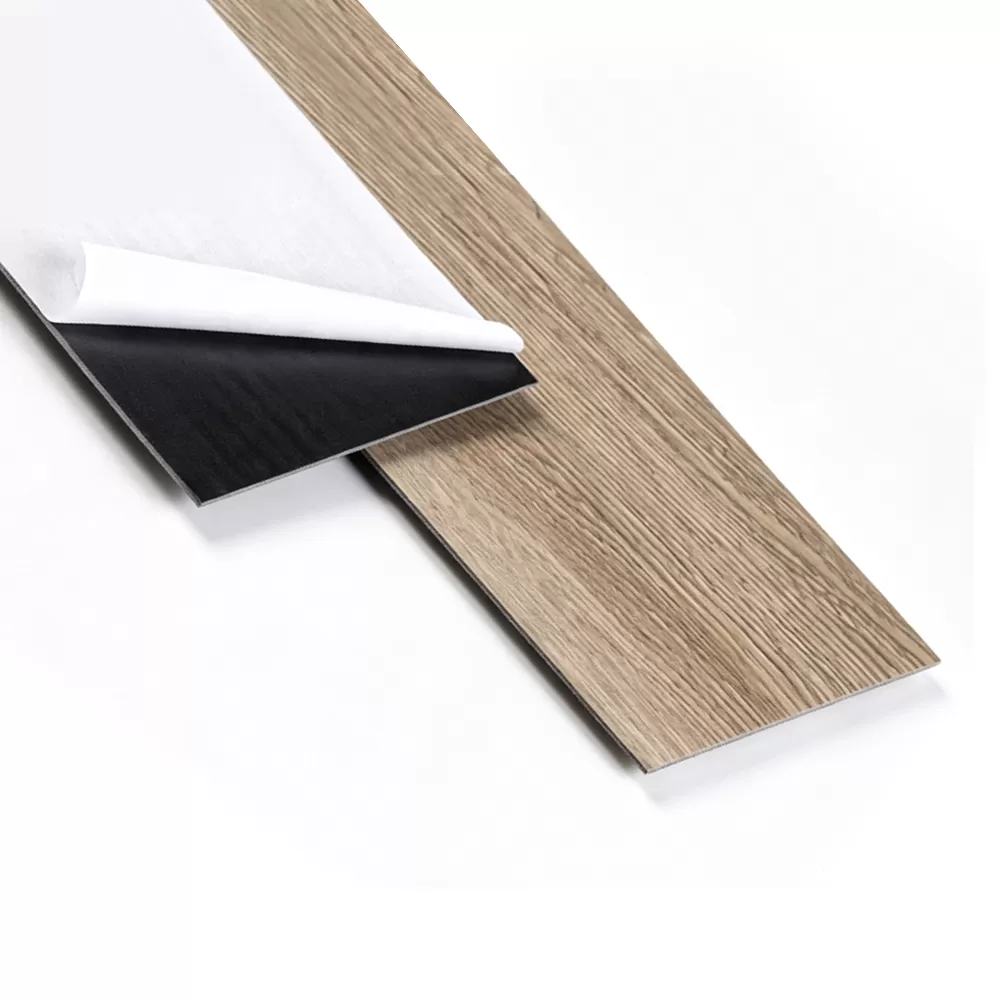
High-performing self adhesive vinyl floor tiles consist of several co-extruded and laminated layers. Customizing each component lets you balance target retail price points with real-world physical durability.
1. Wear Layer Thickness
The clear PVC wear layer sits directly on top of the print film. It shields the floor from micro-scratches, pet claws, and grit. Choosing the right thickness determines your warranty length and ideal application:
0.07mm to 0.10mm: Ideal for budget lines, light-traffic bedrooms, promotional events, and cost-sensitive retail promotions.
0.15mm to 0.20mm: The sweet spot for standard residential private label vinyl flooring. It balances cost with reliable durability for living rooms and kitchens.
0.30mm and above: Premium residential and light commercial grade. Use this spec to position your brand as a heavy-duty, luxury peel-and-stick alternative.
2. Print Film Layer & Pattern Development
Visual appeal drives the initial purchase decision. Modern rotogravure and digital printing technology allow an adhesive floor tile supplier to reproduce organic materials with sharp realism.
You can develop exclusive visual collections instead of relying on generic public designs:
Hyper-Realistic Wood Grain: White oak, weathered pine, walnut, and herringbone layouts.
Natural Stone & Concrete: Carrara marble, slate, poured concrete, and industrial terrazzo.
Artisan Ceramic Patterns: Intricate encaustic Moroccan styles and Victorian geometric designs that hide seams between individual tiles.
Professional OEM suppliers will calibrate color formulas using spectrophotometers to guarantee batch-to-batch consistency. That means reorders six months later match your original run perfectly.
3. Core Material: Virgin PVC vs. Recycled PVC
The core layer gives the tile its body, impact resistance, and structural stability. The raw formulation directly impacts your customer return rate.
Recycled scrap PVC reduces production costs. However, it often contains hidden impurities that compromise dimensional stability. When seasonal room temperatures fluctuate, cheaper recycled cores expand or shrink, leaving visible gaps between seams.
Virgin PVC mixed with balanced calcium carbonate (limestone) costs slightly more, but it maintains dimensional integrity. For reliable brands, choosing 100% virgin or tightly controlled pre-consumer compound prevents post-installation shrinkage claims.
4. Pressure-Sensitive Adhesive (PSA) Formulations
Adhesion failure accounts for the majority of one-star product reviews in this category. The glue must grab smooth underlayments instantly, cure firmly over time, and withstand fluctuating humidity.
Suppliers typically apply one of two adhesive types:
Hot-Melt Adhesive: Offers aggressive initial tack and holds up well against subfloor dust. However, low-grade hot-melt can soften and ooze out of tile edges during high-heat ocean container shipping.
Water-Based Acrylic Adhesive: Provides superior temperature resistance, zero odor, and exceptionally stable long-term bonding without bleed-through.
A reliable manufacturer applies 30 to 45 grams of high-grade adhesive per square meter. This ensures the floor stays anchored to plywood, concrete, or existing ceramic tiles without messy edge bleed.
5. Custom Branded Release Paper
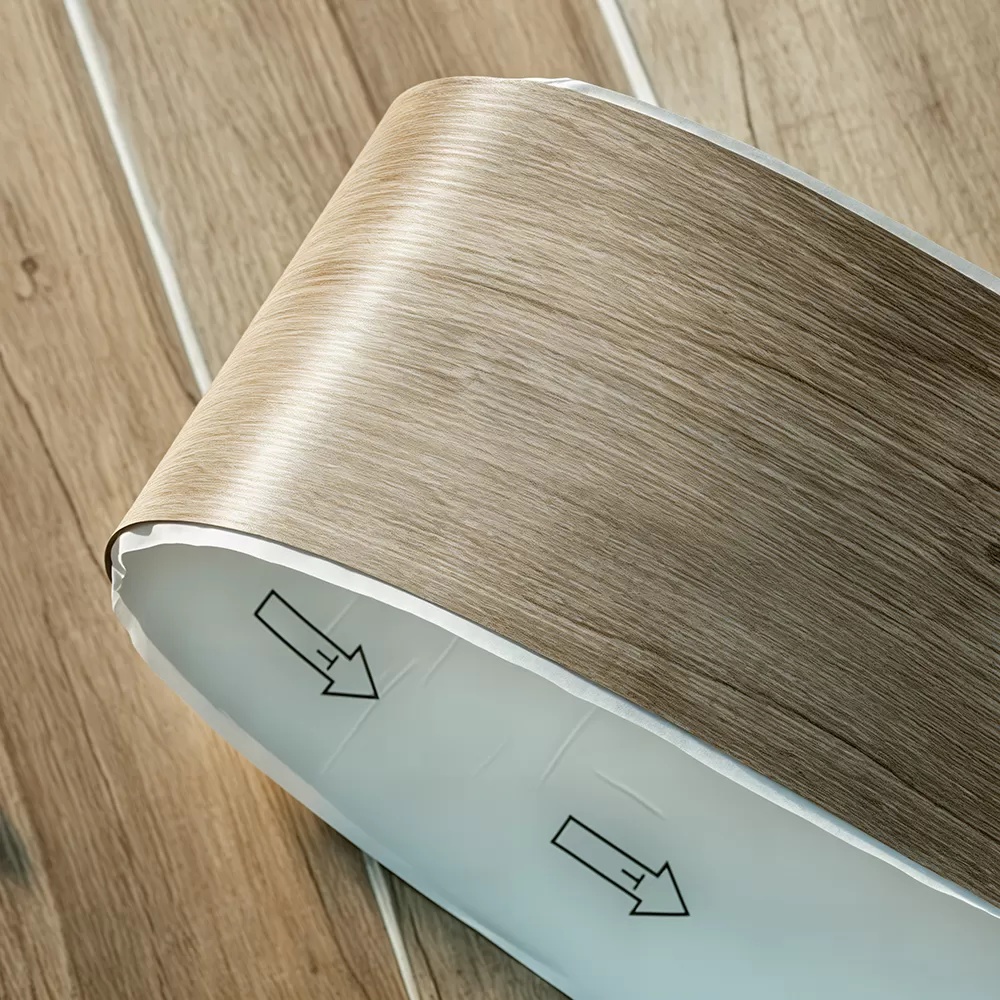
Do not overlook the silicone-coated backing sheet. Generic white or grid-lined release paper looks cheap. High-end private label brands print custom logos, brand taglines, and clear alignment arrows directly on this paper.
A branded backing sheet reinforces product authenticity the moment a customer peels back the first tile.
Tactile Finishes, Edge Profiles, and Sizing Options
Visual style attracts the eye, but texture closes the sale. Flat, smooth plastic surfaces feel synthetic and cheap underfoot. Adding surface depth transforms custom peel and stick floor tiles into realistic flooring alternatives.
Leading factories like TAB Flooring utilize hardened steel pressing plates to emboss distinct tactile textures into the surface wear layer:
Wood Tick / Fine Grain: Subtle, directional micro-grooves that mimic sanded timber.
Deep Slate / Coral: Rough, pitted surfaces that emulate split natural stone and boost wet slip resistance.
Embossed in Register (EIR): The pinnacle of flooring realism. The steel pressing plate synchronizes tactile surface ridges directly with the printed wood grain or stone fissures beneath it.
Edge Finishing: Square Cut vs. Beveled Edge
Square-cut edges butt tightly together to create a seamless, monolithic floor plane. They install quickly and work best for modern, continuous stone and marble finishes.
Micro-beveled edges feature a precise 45-degree angle routed into the perimeter. This cut defines each tile plank, replicating the natural shadow lines of authentic hardwood or grouted stone tiles. It also forgives minor subfloor irregularities during installation.
Versatile Dimensions
Varying tile dimensions help segment your catalog across multiple market applications:
Classic Squares: 12"x12" (305x305mm) and 18"x18" (457x457mm) for traditional bathroom and kitchen floor layouts.
Plank Formats: 6"x36" (152x914mm) and 7"x48" (178x1220mm) for realistic hardwood plank replication.
Hexagons & Shapes: Geometric configurations for trendy backsplashes and accent areas.
Packaging Engineering for Modern Retail and E-Commerce
Self adhesive vinyl floor tiles are heavy, dense, and vulnerable to corner impacts. If you sell through Amazon FBA or direct-to-consumer e-commerce, poor packaging will crush your margins with freight damage returns.
E-Commerce Drop-Test Packaging
Standard retail boxes collapse when dropped on concrete by parcel carriers. Online fulfillment requires engineered packaging that passes ISTA-1A or 3A drop tests.
Specify reinforced 5-ply corrugated master cartons, internal high-density foam corner protectors, and heavy-duty shrink-wrapping. These buffers keep tile edges crisp and prevent transit shock fractures.
Retail-Ready Displays (PDQ) and Color Boxes
If you supply home improvement centers, your packaging must sell itself from the shelf. Work with your supplier to produce structural display solutions:
Die-Cut Color Boxes: Sturdy boxes with integrated carry handles and clear cutout windows that allow shoppers to feel the embossed texture.
PDQ Display Trays: Pre-packed cardboard counter or pallet displays that store associates can place directly onto store shelves.
Multi-Language Instructions: Clear, illustrated installation manuals, surface preparation guides, and localized barcode formats (UPC, EAN-13).
Quality Control, Compliance, and Production Economics
Importing flooring into Europe and North America requires strict compliance with environmental and consumer safety regulations. A single customs hold or safety violation can halt your business.
Ensure your factory provides full documentation and testing certifications for your target region:
FloorScore & Indoor Air Quality: Validates low VOC emissions so installed tiles do not release harmful chemical fumes into homes.
REACH & RoHS Compliance: Essential for EU markets. Confirms the product contains no heavy metals, harmful plasticizers, or banned ortho-phthalates.
CE Marking / EN 14041: Certifies fire resistance (Class Bfl-s1 or Cfl-s1), slip resistance, and thermal conductivity.
Crucial In-House Factory Testing
Before releasing your production batch, your factory should execute three baseline performance tests:
180-Degree Peel Adhesion Test: Measures the force required to pull the adhesive layer from standard steel and concrete test plates.
Dimensional Stability & Curling Test: Exposes finished tiles to 80°C heat for 6 hours, followed by cooling, to confirm shrinkage stays below 0.15%.
Taber Abrasion Test: Runs weighted abrasive wheels over the wear layer to confirm it withstands thousands of continuous wear cycles.
Managing MOQs, Lead Times, and IP Exclusivity
The primary hurdle in custom manufacturing is balancing minimum order quantities (MOQs). Print film suppliers generally require a minimum purchase of 1,000 to 2,000 meters per print run.
To optimize cash flow, negotiate an agreement where the factory stores your master printed film rolls and converts them into finished tiles across rolling purchase orders. This structure helps you launch multiple tile patterns without tying up capital in excessive finished inventory.
Always secure pattern exclusivity agreements for custom designs you develop. This legal barrier prevents your manufacturer from selling your proprietary patterns to competitors in your territory.
Frequently Asked Questions (FAQ)
Q1: What is the ideal total thickness for private label self adhesive
vinyl floor tiles?
A1: For residential DIY use, 1.5mm to 2.0mm
offers the best balance of flexibility, cost, and subfloor masking. Thin 1.0mm
to 1.2mm options work well for ultra-budget lines, while 2.5mm tiles serve
premium collections that demand high structural weight.
Q2: How do you prevent edge peeling and glue bleed during ocean
transit?
A2: Edge peeling and bleed occur when low-grade adhesives
melt under high container temperatures. Partner with a manufacturer that uses
stabilized acrylic pressure-sensitive glue and maintains a 1mm adhesive setback
margin along the tile edges to prevent seepage under pressure.
Q3: Can OEM factories match our existing brand colors or wood
swatches?
A3: Yes. Experienced manufacturers can match physical
flooring planks, textiles, or Pantone color codes. The factory creates custom
gravure printing cylinders or runs short-run digital trials until the film
matches your sample under standard D65 lighting.
Q4: What are the standard lead times for custom OEM peel and stick
tiles?
A4: Physical lab dip sampling and packaging strike-offs
typically take 7 to 10 days. Mass production runs usually require 25 to 35 days
after final sample approval, depending on the volume and packaging
complexity.
Q5: What is the typical MOQ for custom branded packaging and film
designs?
A5: Custom branded boxes and color liners typically carry
an MOQ of 2,000 to 3,000 square meters. If you select existing in-stock print
films, MOQs can drop to as low as 500 to 1,000 square meters per colorway.
Build Your Custom Flooring Line with TAB Flooring
Customizing self adhesive vinyl floor tiles allows you to escape price wars and build lasting equity in your own brand. Controlling your wear layers, core materials, adhesives, and packaging ensures a premium customer experience that generates repeat orders.
TAB Flooring operates precision manufacturing lines that produce certified, export-ready resilient flooring for global brands. Whether you need drop-tested packaging for an online store or high-volume shipments for regional home centers, our engineering team handles every step of production.
Ready to launch your custom collection? Contact the TAB Flooring engineering team today to submit your technical specifications, discuss target pricing, and request your comprehensive customization swatch kit.