You send the exact same specification sheet to five different Chinese or Southeast Asian factories. One week later, the quotes come back with a 35% price spread. Why does one OEM vinyl flooring factory quote $7.50 per square meter while another demands $11.00 for what looks like the identical product?
The answer is simple: what is written on a quotation sheet rarely tells the full story of what happens on the calender line. In the flooring manufacturing world, tiny formulation changes yield massive margin differences. If you do not know where suppliers cut corners, your brand absorbs the fallout through customer claims, dimensional failures, and delayed port clearances.
At TAB Flooring, we believe long-term business relies on engineering transparency rather than smoke and mirrors. Whether you are building an OEM private label or sourcing for massive commercial developments, here are five manufacturing secrets you need to know before issuing your next purchase order for custom LVT vinyl flooring.
Secret 1: Total Thickness Is Vanity, Wear Layer Chemistry Is Sanity
Many buyers obsess over total plank thickness. They insist on 4.0mm or 5.0mm dry back planks, assuming thicker automatically means stronger. Factories love this mistake because limestone filler (calcium carbonate) is dirt cheap, while the transparent PVC wear layer is one of the most expensive components of the build.
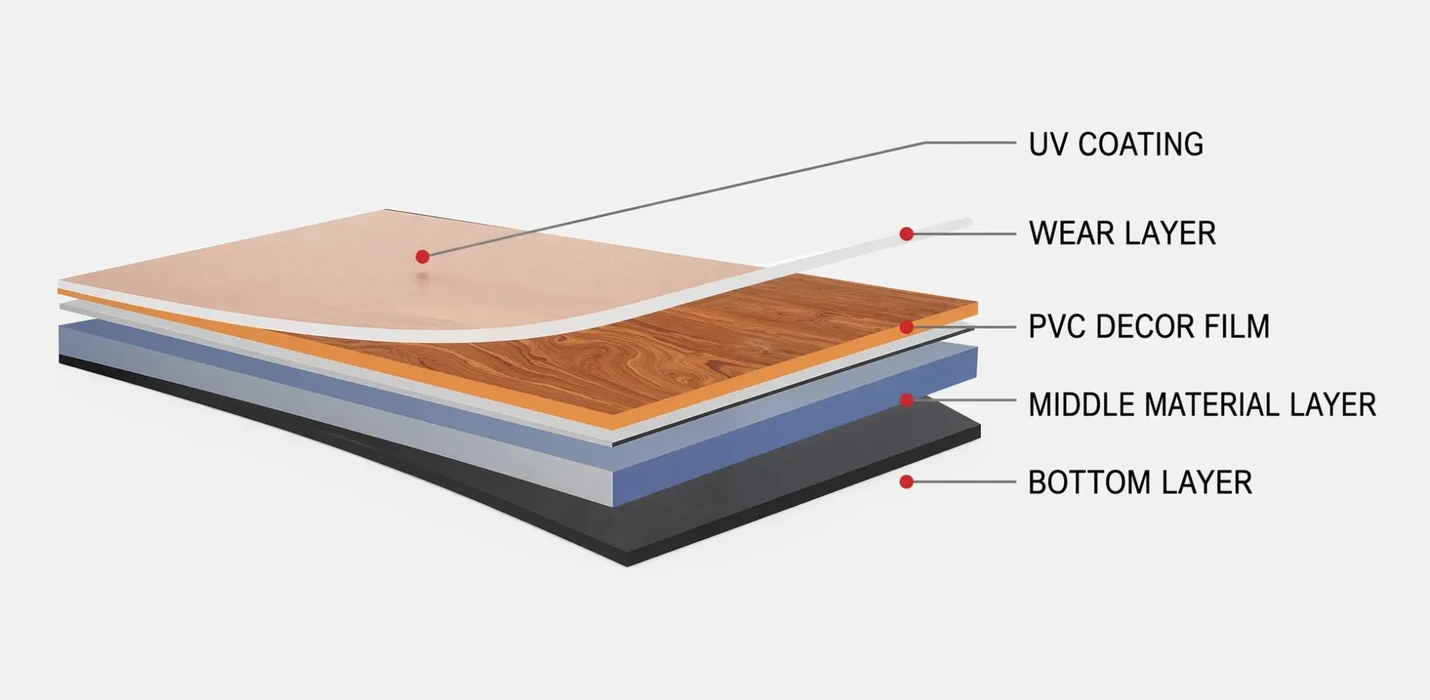
A supplier can easily offer you a 5.0mm plank paired with a tissue-thin 0.15mm (6mil) wear layer. That floor will dent and scratch within three months of residential foot traffic. Conversely, a 2.5mm plank built with a high-grade 0.55mm (22mil) wear layer will survive a bustling hospital corridor for over a decade.
The real secret, however, lies inside the wear layer coating formulation. Standard PVC film scratches relatively easily under abrasive dirt. Quality commercial LVT vinyl plank production applies an inline ultraviolet (UV) cured polyurethane finish directly on top of the wear layer. But not all UV coatings perform equally:
Standard UV: Basic stain resistance. Offers minimal scratch protection against grit.
Aluminum Oxide UV: Microscopic particles suspended in the lacquer that dramatically deflect everyday abrasion.
Ceramic Bead Technology: Premium microscopic ceramic spheres cured into the finish, providing superior scuff and micro-scratch defense under heavy rolling loads.
When engineering your custom line, do not just request a "UV coat." Instruct your supplier to specify the coating chemistry and the dry coat weight per square meter. If your project demands commercial compliance, demand a minimum 20mil (0.50mm) wear layer fortified with ceramic bead technology.
Secret 2: The "100% Virgin Material" Semantic Trap and Shrinkage
Ask any factory sales representative if their core uses virgin resin, and the answer is almost always an enthusiastic "Yes, 100% virgin material!" Technically, they might not be lying to you. In factory jargon, however, "virgin" often includes post-industrial recycled material (PIR)—the factory’s own trimmed edges, balance waste, and unprinted rejects run through a granulator and fed back into the extrusion line.
There is nothing inherently wrong with clean internal regrind when it is measured carefully (under 10% to 15%). But when factories push that ratio to 40% or source cheap post-consumer waste, the chemical balance collapses. The plasticizer content destabilizes, causing two critical failures in finished lvt vinyl flooring:
Plasticizer Migration: The core loses flexibility over time, turning brittle and chalky.
Thermal Shrinkage and Edge Curling: When subjected to sunlight through glass doors, the planks warp upward at the seams, popping loose from the subfloor.
How do premium manufacturers solve this? Through proper annealing lines. Annealing is a controlled heating and gradual cooling process that relieves mechanical stress locked into the vinyl during high-pressure calendering. Cheaper factories run their annealing lines at double speed to boost daily output, leaving residual tension inside the vinyl sheets.
To protect your brand, always write international testing parameters into your contracts. Specify that your production lots must pass ASTM F2199 (Standard Test Method for Determining Dimensional Stability of Resilient Floor Tile after Exposure to Heat) with shrinkage values lower than 0.15% and curling not exceeding 0.5mm.
Secret 3: Print Film Traps—Cylinder Fees vs. Stocked Film Hacks
Developing a signature visual identity is the fastest way to stop price erosion in your home market. However, creating a completely custom decor film requires engraving brand-new copper rotogravure printing cylinders. With four to six color separations per design, cylinder setup fees can quickly run between $6,000 and $12,000 per pattern, accompanied by massive minimum order quantities (MOQs) of 20,000 square meters or more.
Unscrupulous brokers exploit this barrier. They take stock print patterns readily available to hundreds of companies, rename the color codes, and sell them to unwary buyers as "exclusive designs." Within six months, you discover your local competitor selling the exact same wood pattern for $1.00 less per box.
You can create a proprietary look without paying massive cylinder charges by leveraging smart manufacturing hacks:
Surface Texture Swapping: Combine a standard European Oak decor film with an uncommon deep wire-brush or authentic hand-scraped embossing plate.
Embossed-in-Register (EIR) Alignment: Match the tactile wood grain physically to the print design beneath. This elevates an ordinary film into an architectural-grade product.
Custom Cut Formats: Take standard wood patterns and press them into herringbone planks (e.g., 4" x 24"), or convert marble patterns into oversized rectangular formats (e.g., 18" x 36").
At TAB Flooring, we keep hundreds of vetted, high-definition print films in rolling stock. This setup lets private-label clients combine exclusive embossing plates with regional territorial exclusivity agreements, cutting upfront tool investments down to zero.
Secret 4: Pre-Attached Underlayment and Adhesive Degradation
Loose-lay and acoustic dry-back products frequently feature integrated backing layers such as IXPE (irradiated cross-linked polyethylene), EVA foam, or recycled vinyl traction backings. While convenient for installers, these composite setups contain a hidden failure point: the bonding interface.
Some low-tier factories use cheap water-based pressure-sensitive adhesives (PSA) or substandard hot melts to attach acoustic pads to the back of the LVT plank. When your container spends four weeks crossing the ocean, temperatures inside the steel shipping box can easily surpass 60°C (140°F) with high humidity.
Under these harsh conditions, weak adhesives degrade. Planks arrive at your distribution warehouse with delaminating pads, or worse, the adhesive begins off-gassing volatile organic compounds (VOCs), failing domestic indoor air quality testing. Unstable backings can also leach low-grade oils into concrete subfloors, causing adhesive failures on jobsites months down the road.
When selecting your custom LVT vinyl flooring build, require the following validations:
Demand FloorScore or CRI Green Label Plus certifications to verify that the integrated composite backing complies with strict chemical emissions limits.
Mandate a mechanical peel-strength test of the underlayment after thermal aging (7 days at 60°C).
For heavy commercial projects, skip complex backings entirely and opt for standard square-edge dry-back planks glued down using a premium hard-set acrylic adhesive.
Secret 5: Dimensional Tolerances and Container Payload Bleed
Unlike laminate or rigid core SPC, standard LVT is dense, flexible, and exceptionally heavy. A standard 20-foot shipping container hits its maximum road weight limit (typically 21 to 22 metric tons depending on the destination port) long before the container volume is physically full. Inexperienced buyers focus solely on price per square meter, failing to calculate packaging optimization.
If a factory uses uncalibrated, heavy filler formulations without tight density controls, the weight per square meter climbs unexpectedly. You end up shipping fewer square meters per container, driving your landed freight cost per unit through the roof.
Worse yet is the issue of cutting precision. Traditional punch-cutting machines wear down quickly. When blades dull, the factory produces planks with micro-deviations in squareness:
Out-of-Square Tolerances: A deviation of just 0.2mm on a long edge causes visible gap build-ups over a 10-meter run. Installers will charge extra labor or walk off the site entirely.
Bevel Inconsistencies: If your specification calls for micro-bevel edges, uncalibrated milling heads will cut uneven depths, exposing raw core material or cutting through the wear layer.
To safeguard your margins, write an Acceptable Quality Limit (AQL) of 1.0 on squareness and thickness into your quality control contract. Require your custom LVT flooring manufacturer to submit mill-inspection reports that verify dimensions using digital optical measurement tables rather than manual calipers.
The OEM RFQ Checklist: 7 Specifications You Must Lock Down
To stop factories from quoting on cheap baseline assumptions, never submit an open-ended request for quotation. Always copy, paste, and complete this exact technical grid when negotiating your custom LVT vinyl flooring production runs:
| Technical Parameter | Budget Factory Default (Risk Area) | Professional Specification Target | Standard Reference |
|---|---|---|---|
| Wear Layer Thickness | 0.1mm - 0.2mm (nominal/under-gauged) | 0.55mm (22mil) true gauge | ASTM F1700 Class III |
| Wear Layer Additives | Standard solvent-based lacquer | UV Cured Ceramic Bead / Al2O3 | Taber Abrasion (EN 660-2) |
| Core Composition | High scrap regrind / unknown filler ratio | 100% Controlled Virgin PVC + pure CaCO3 | REACH / RoHS compliant |
| Dimensional Stability | Short annealing; >0.25% shrinkage | Full thermal cycle; ≤0.12% shrinkage | ASTM F2199 / ISO 23999 |
| Squareness & Flatness | Tolerance ±0.40mm | Tolerance ≤0.15mm (CNC punch cut) | ISO 24342 |
| Indoor Air Quality | Basic factory self-declaration | FloorScore or Eurofins Indoor Air Comfort | CDPH Section 01350 |
| Bevel Finish | Unpainted / rough V-groove | Micro-bevel with color-matched lacquer | Visual inspection under 1000 lux |
Frequently Asked Questions (FAQ)
Q1: What is the primary difference between LVT and SPC flooring for
commercial installations?
A1: LVT (Luxury Vinyl Tile) is a flexible
vinyl plank composed primarily of PVC resin and calcium carbonate, yielding a
resilient, quiet feel underfoot that glues directly to the subfloor. SPC (Stone
Plastic Composite) features an ultra-rigid core with a higher limestone ratio,
typically installed via a floating click-lock system. For heavy rolling loads
(such as hospital beds or retail pallets), glue-down LVT vinyl flooring remains
the commercial gold standard because it will not separate or snap at the joints
under stress.
Q2: How do I verify if a factory is truly using virgin PVC
resin?
A2: Request a thermal stability and flexibility test report
alongside chemical screening. Snap a plank completely in half: a core loaded
with cheap recycled filler will snap cleanly like chalk and show inconsistent
black flecks in the center. A high-grade virgin PVC plank will bend
significantly before breaking, exhibiting a uniform white or light grey
coloration throughout the base layer.
Q3: What wear layer thickness is ideal for multi-family residential
housing?
A3: For multi-family apartments and rental properties,
balance initial purchase cost with long-term wear resistance. A 0.30mm (12mil)
wear layer paired with a durable ceramic bead UV finish is the industry
benchmark. It withstands pet claws, tenant turnover, and furniture movement
while keeping production costs significantly lower than 0.55mm (22mil)
commercial grades.
Q4: Why does my imported LVT cup or curl along the edges after
installation?
A4: Cupping or curling is almost always caused by
improper annealing during production or lack of on-site acclimation. If the OEM
vinyl flooring factory runs the cooling line too quickly, internal stress stays
trapped within the material. When the planks encounter room temperature
variations after installation, those stresses release, causing the edges to
curl. Planks must also acclimate to the jobsite environment for at least 48
hours before glue-down.
Q5: What is the typical Minimum Order Quantity (MOQ) for custom LVT
designs?
A5: For standard thicknesses using factory-stocked print
films, production runs usually start around 1,000 to 1,500 square meters per
color. If you require custom packaging, proprietary plank dimensions, or a
dedicated decor film that the factory must order from a third-party printer,
MOQs generally climb to 3,000 to 5,000 square meters per SKU.
Build Your Custom Flooring Line on Solid Engineering
Sourcing your product overseas should not feel like gambling. Once you know which raw material balances matter, how annealing lines work, and how wear layers are properly coated, you can spot predatory pricing immediately. You will protect your bottom line, keep claims near zero, and supply flooring that builds your brand's reputation for years to come.
At TAB Flooring, we eliminate the guesswork from custom resilient flooring production. We welcome strict technical audits, run certified ASTM quality procedures on every production lot, and deliver transparent OEM manufacturing solutions for distributors, developers, and flooring brands worldwide.
Planning your next product release or need an engineering review of your current spec sheet? Contact the TAB Flooring engineering team today to request our comprehensive technical specifications pack or order a custom commercial sample box built to your precise project requirements.
Get in touch: admin@flooringmanufacture.com | www.flooringmanufacture.com