Minimalist architecture demands discipline. Every trim, reveal, and floor transition either strengthens the design or exposes its flaws. When you eliminate decorative moldings and heavy baseboards, material quality must carry the space.
For builders, designers, and homeowners seeking high-end modernism without structural compromises, the combination of MDF painted doors and wood-look stone polymer composite (SPC) flooring has become an architectural staple. At TAB Flooring, we supply project-ready surface solutions engineered to meet rigorous commercial performance standards and residential design goals alike.
Planning a multi-family project or a custom interior fit-out? Contact our technical team today to request material specifications, finishes, and factory-direct volume pricing.
1. The Power of Material Pairing in Modern Minimalism
Modern minimalism is not simply empty space. It is a calculated balance between planes, light, and tactile feedback. The two largest continuous surfaces in any interior are the vertical envelope—walls and interior doors—and the horizontal plane of the floor.
If every surface is smooth and white, the room feels sterile, like a clinical laboratory. Conversely, if you fill a room with competing wood species across doors, floors, and cabinetry, visual noise destroys the minimalist calm.
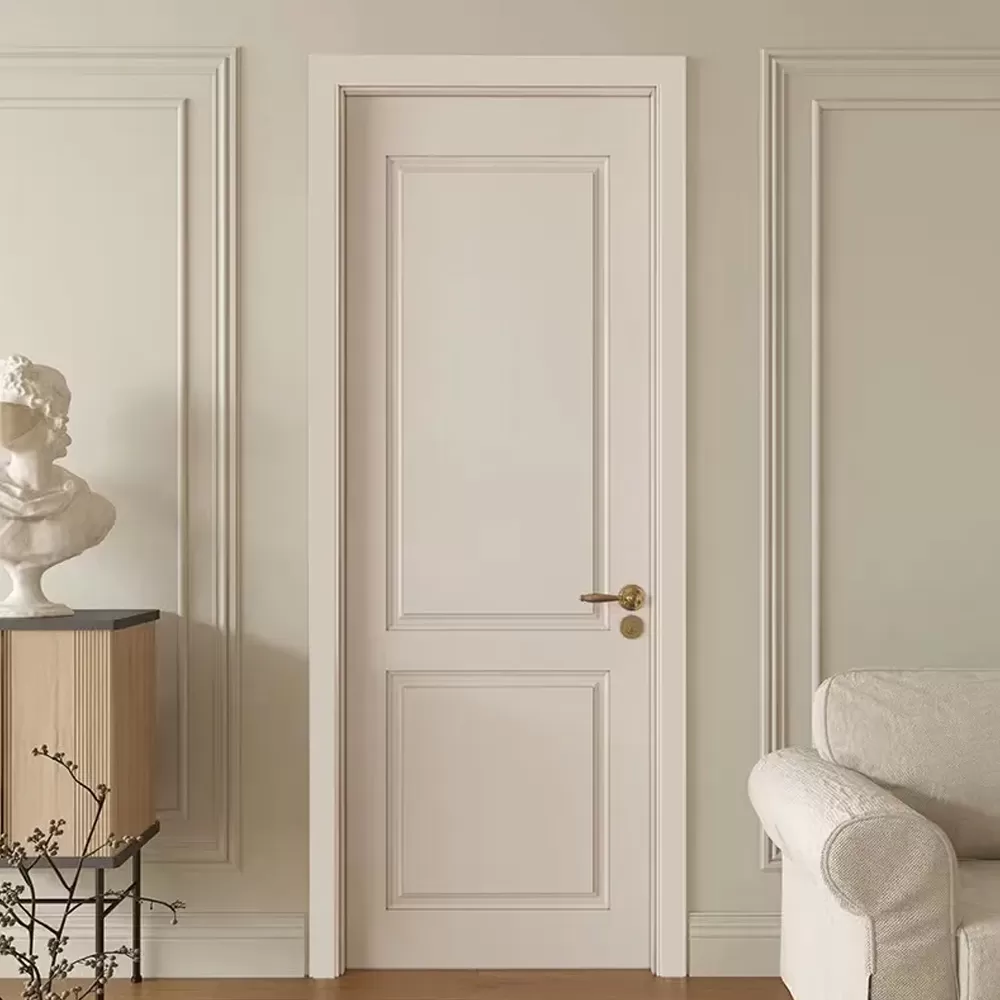
The solution lies in deliberate material contrast. Pairing ultra-smooth MDF painted doors with textured, wood-grain SPC planks balances crisp industrial precision with organic warmth. The flat, non-porous face of a painted flush door allows the eye to rest, while the micro-beveled grain of an SPC plank grounds the room with tactile realism.
2. Why MDF Painted Doors Define Modern Minimalist Interiors
Solid lumber has a storied history, but it struggles in minimalist details. Natural timber expands across its grain with seasonal humidity shifts, creating hairline paint cracks at panel joints. Medium Density Fiberboard (MDF) solves these engineering challenges.
Flawless Surface Smoothness
Natural wood possesses open grain, mineral streaks, and knots. These irregularities show through smooth lacquer coats. High-grade engineered fiberboard provides an isotropic structure with uniform density from surface to core. There is no telegraphing grain or seasonal checking. The door blade takes multi-coat polyurethane or waterborne paint finishes with mirror-flat consistency, which is vital for modern flush aesthetics.
Superior Dimensional Stability
Minimalist interior doors often feature square edges, slim jambs, or trimless concealed frames. These assemblies permit tiny gaps of only 3mm to 4mm between the slab and the frame. If an interior door warps even slightly, it rubs against the jamb or sticks. Painted MDF interior doors resist hygroscopic movement, maintaining straight profiles through alternating dry winters and humid summers.
Limitless Color Precision
Modern minimalist color palettes have moved beyond basic hospital white. Designers now specify nuanced warm whites, putty tones, chalky charcoals, and muted sage greens. Factory-applied paint systems on MDF ensure exact color matching across hundreds of door units, guaranteeing that your doors match adjoining millwork, wall panels, or metal accents.
Engineered for Floor-to-Ceiling and Flush Openings
Full-height doors (2.4m to 3m tall) represent a hallmark of contemporary luxury. Solid wood doors of this height tend to twist under their own weight. In contrast, an engineered solid core skinned with dense MDF panels resists deflection, remaining true over years of heavy cycling.
3. Design Harmony: Pairing MDF Painted Doors with Wood-Look SPC Planks
Achieving a cohesive interior requires harmonizing the vertical paint finish with the horizontal floor plank. TAB Flooring engineers high-definition wood-look SPC planks that complement the monolithic nature of smooth painted doors, producing balanced, functional environments.
Palette 1: Scandinavian Soft Minimal (Crisp White + Pale Oak)
- Interior Door: Pure white (RAL 9003) or signal white in a dead-matte finish.
- SPC Flooring: Pale Scandinavian white oak with low contrast, wire-brushed ticking, and subtle beige undertones.
- Visual Result: Maximum daylight reflection. The floor introduces soft warmth, preventing the crisp white doors and pale walls from feeling washed out.
Palette 2: Warm Minimalist & Japandi (Warm Greige + Natural Walnut)
- Interior Door: Soft greige, mushroom, or pale taupe matte painted doors.
- SPC Flooring: Mid-tone honey oak or deep natural walnut with realistic grain depth.
- Visual Result: Organic and calming. The warm painted vertical surfaces soften direct lighting, while the deeper wood-tone floor anchors the architecture.
Palette 3: Monochromatic Italian Modern (Deep Charcoal + Smoked Gray Timber)
- Interior Door: Anthracite, dark graphite, or deep slate painted flush doors.
- SPC Flooring: Smoked gray or weathered ash wood-pattern SPC planks with authentic embossed-in-register (EIR) textures.
- Visual Result: High-contrast drama suited for executive residential projects and boutique commercial hospitality spaces.
4. Beyond Aesthetics: Practical Benefits & Durability
Interior specifications must survive real-world traffic. High-end visual appeal means little if doors chip easily or flooring buckles under moisture exposure.
Advanced Paint Finishes on Engineered Substrates
Modern factory-applied paint technologies protect high-traffic MDF doors from scuffs, hand oils, and cleaning chemicals. Multi-pass UV-cured or multi-component polyurethane systems form a tough shell over the board. Unlike field-painted doors, factory-finished MDF surfaces offer uniform thickness, clean edge radiuses, and reduced VOC emissions on the jobsite.
Indestructible Underfoot: The SPC Advantage
Traditional hardwood flooring looks stunning on day one, but it remains susceptible to scratches from pets, moisture damage in entryways, and denting from high heels. Stone polymer composite (SPC) flooring eliminates these vulnerabilities. Built with a rigid limestone-composite core, a high-clarity printed vinyl layer, and a clear polyurethane wear layer, SPC flooring delivers exceptional practical advantages:
- 100% Waterproof: Can be run seamlessly from bedrooms into bathrooms, creating unbroken floor planes without transition strips.
- High Impact Resistance: Dense cores prevent indentation from heavy minimalist furniture and high foot traffic.
- Acoustic Isolation: Attached acoustic underlayment dampens footfall noise, which pairs well with heavy-core doors to block sound between rooms.
Total Life-Cycle Return on Investment
Specifying custom solid timber doors alongside wide-plank engineered hardwood often drains project budgets without delivering tangible performance gains. Replacing them with MDF painted doors and high-performance SPC planks provides identical visual clarity and better durability at a fraction of the procurement and maintenance cost. For multi-unit developments, this pairing protects profit margins while maintaining high market valuations.
5. Buyer’s Guide: What to Look for in MDF Painted Doors
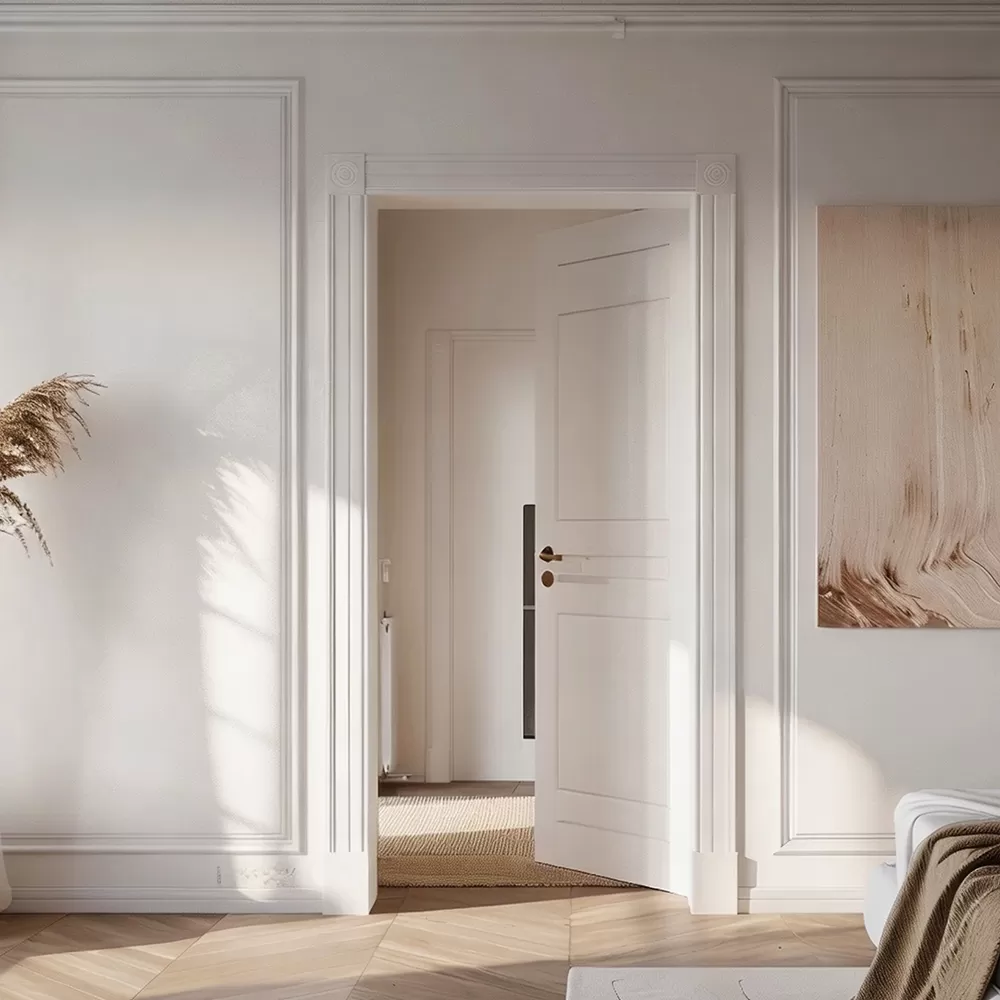
Not every painted interior door delivers equal performance. When specifying for commercial projects or luxury homes, inspect these three core criteria:
1. Paint Formulation and Sheen Level
For minimalist interiors, avoid high-gloss finishes unless specified for an intentional art-deco look. High-gloss finishes reflect glare and expose even minor dust particles. Instead, select matte (5-10% sheen) or satin/eggshell (15-20% sheen) coatings. Ask your manufacturer whether they use water-based polyurethane or UV-cured acrylic lacquers, both of which provide superior yellowing resistance against sunlight exposure.
2. Core Construction Types
The interior structure of the door slab dictates its physical heft and acoustic dampening:
- Hollow Core: Lightweight, economical, but sounds hollow when tapped. Not recommended for luxury projects.
- Tubular / Particleboard Core: Provides balanced weight, moderate sound suppression (STC 28-32), and stable screw-holding capacity for modern hardware.
- Solid MDF / Composite Core: Offers maximum acoustic privacy, substantial hand feel, and exceptional resistance to physical impact. Recommended for master suites, meeting rooms, and executive spaces.
3. Modern Minimalist Hardware Prep
Minimalist architecture relies on clean perimeter lines. Ensure your door manufacturer precision-mills for hidden hardware:
- Concealed 3D Hinges: Fully hidden when the door is closed, allowing completely flush integration with wall planes.
- Magnetic Latch Locks: Eliminate standard protruding strike plates; the latch bolt stays retracted until the door aligns with the frame, resulting in silent closing and a flush door edge.
6. Frequently Asked Questions (FAQ)
Q1: Are MDF painted doors better than solid wood doors for minimalist interiors?
A1: Yes, for modern flush designs, MDF is generally superior. Unlike natural solid wood, MDF lacks directional grain, knots, and natural growth stress. It will not expand, contract, or warp with seasonal changes, ensuring the razor-thin door reveals and flush wall alignments required in minimalist architecture remain true.
Q2: How do MDF doors hold up against moisture in bathroom applications?
A2: High-grade moisture-resistant MDF (MR-MDF) sealed on all six sides with factory-applied polyurethane paint performs reliably in humid bathroom environments. Because the paint envelope prevents steam penetration, these doors resist swelling better than natural wood. However, direct prolonged standing water contact should always be avoided.
Q3: Will the smooth finish on painted MDF doors show fingerprints easily?
A3: High-gloss finishes can show prints, but modern matte and satin factory-applied lacquers contain micro-surface additives that resist oil transfer. Regular cleaning with a damp microfiber cloth and neutral soap keeps the surface pristine without damaging the topcoat.
Q4: Can I match the color of my MDF painted doors to my baseboards and trim?
A4: Yes. Commercial manufacturers work with universal color systems such as RAL, NCS, or custom paint formulations. This allows you to match flush baseboards, shadowline reveals, and wall panels directly to your door slab for a continuous monochromatic appearance.
Q5: Why choose wood-look SPC planks instead of genuine hardwood alongside smooth doors?
A5: Wood-look SPC planks provide the authentic visual warmth and embossed texture of timber without the maintenance headaches. SPC is 100% waterproof, scratch-resistant, and dimensionally stable. This enables unbroken flooring runs through kitchens, bedrooms, and bathrooms without unsightly transition t-moldings, complementing the clean visual flow of minimalist spaces.
7. Build Your Minimalist Interior with TAB Flooring
Minimalist architecture demands strict material precision. Pairing MDF painted doors with wood-pattern SPC flooring bridges the gap between pure industrial design and comfortable day-to-day living. You gain clean sightlines, consistent finishes, and durable surfaces that hold up under heavy foot traffic.
At TAB Flooring, we collaborate with property developers, architects, and specialty distributors worldwide. We supply factory-direct SPC flooring collections and precision architectural door solutions tailored to your project schedule and technical specifications.
Ready to upgrade your next residential or commercial project? Contact our technical sales division today to request sample boxes, download acoustic and fire rating data, or receive a fast quote for custom project manufacturing.