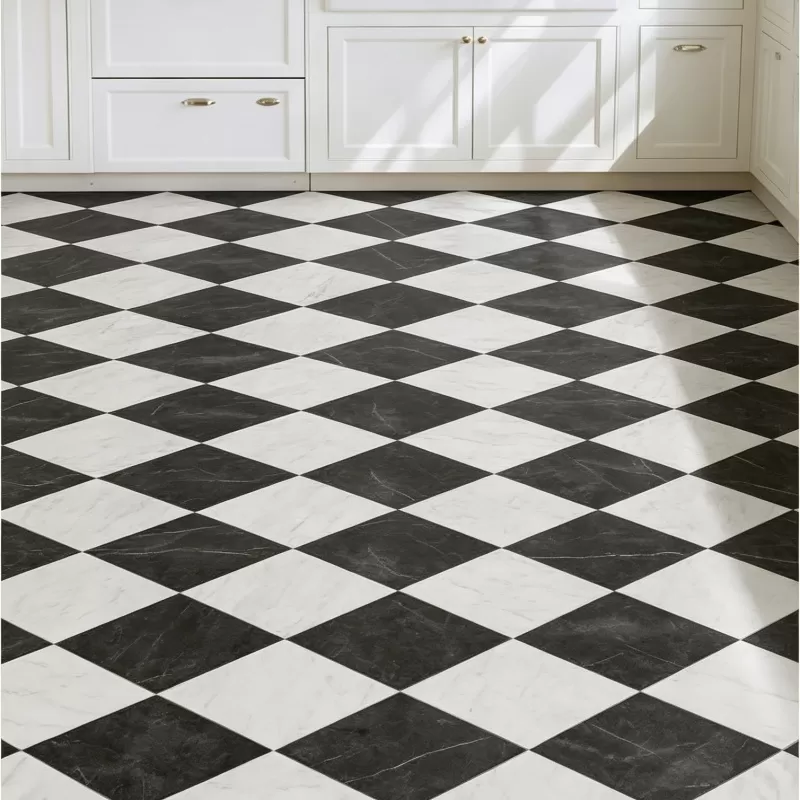
Commercial interior architecture has steadily shifted away from conventional monolithic formats toward dynamic geometric expressions. Floor designs relying exclusively on standard rectangular planks or square modular tiles often fail to provide the distinct spatial zoning and visual articulation demanded by contemporary hospitality, corporate, and retail environments. Among non-orthogonal geometries, the diamond or equilateral parallelogram format provides unique optical versatility, enabling floor patterns that alternate between isometric cubes, chevron variations, and multi-tone hexagonal mosaics.
Executing these patterns using resilient materials requires high technical capability. Specifying a rhombus shaped tile engineered from Stone Plastic Composite (SPC) or Luxury Vinyl Tile (LVT) involves understanding mechanical tolerances, click-system profiles, expansion dynamics, and raw material formulation. While standard rectangular planks permit minor axial variances along straight runs, multi-angled layouts multiply geometric discrepancies exponentially across a floor plane. Sourcing and installing diamond configurations requires rigorous attention to dimensional stability, acoustic dampening, and profile milling.
Geometric Modularity: The Physics of Non-Orthogonal Resilient Flooring
The standard rhombus tile typically relies on an equilateral geometry with interior angles measuring 60 degrees and 120 degrees. This specific angular pairing forms the baseline for several classical geometric configurations, notably the three-dimensional "tumbling block" illusion, six-pointed stars, and large-scale hexagonal modules. When three matching tiles meet at their acute 60-degree vertices, they construct a continuous 180-degree straight line; conversely, when six acute points converge, they form a closed 360-degree hub.
Non-orthogonal intersections introduce rotational torque and multi-directional shear stresses absent in traditional staggered plank layouts. In a standard floating installation, expansion and contraction occur primarily along longitudinal and transverse axes. A layout incorporating angled modules distributes thermal movement along diagonal vectors. Without precise engineering, dimensional shifts induce lateral pressure points that can compromise joint integrity, producing micro-gapping or edge peaking at the vertices.
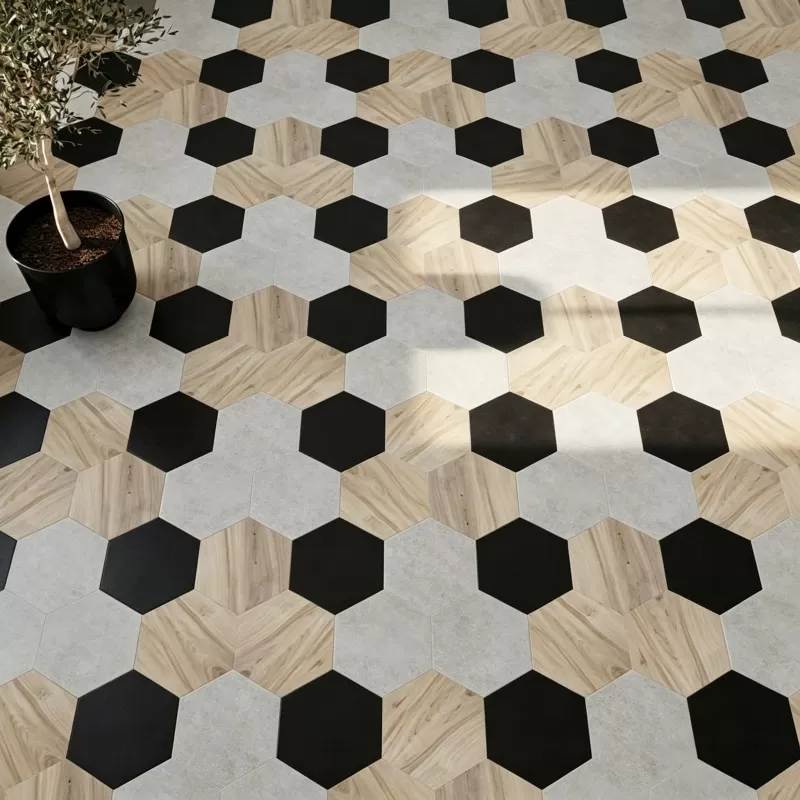
Floor designs often combine varied colorways, textures, and surface finishes within the same installation field to accentuate depth. This approach requires strict uniformity in core density and thickness across production runs. Even a discrepancy of 0.05 millimeters in profile depth between contrasting color runs can generate premature wear, edge chipping, and maintenance issues under heavy rolling loads.
Manufacturing Precision: Milling and Dimensional Tolerances
Producing a high-performance rhombus shaped tile demands advanced cutting and profiling technologies far exceeding the standards applied to mass-market vinyl planks. Standard four-sided rectangular profiling utilizes inline longitudinal and cross tenoners operating on continuous belts. In contrast, profiling 60-degree and 120-degree corners requires specialized multi-axis CNC profiling stations or angular double-end tenoners equipped with laser-guided feed tables.
Angular Accuracy: Cutting heads must hold angular tolerances within ±0.05 degrees. A variation of merely 0.1 degrees across ten consecutive tiles shifts the layout off-axis, making seamless engagement of the locking mechanism impossible.
Milling the Locking Profile: For floating SPC floors, carving a tongue-and-groove drop-lock or angle-angle system along an acute angle demands specialized tool steel or diamond-tipped cutters running at continuous high RPMs to prevent micro-fracturing the limestone-polymer core.
Micro-Bevel Uniformity: Edge bevelling must follow the acute and obtuse angles without over-cutting the corner junctions. Inconsistent bevel depths yield uneven visual gaps where several vertices converge.
Advanced manufacturers like TAB Flooring address these processing demands by deploying high-stability German profiling lines adjusted specifically for non-standard geometric matrices. By stabilizing the core material through extended thermal annealing cycles before profiling, internal stresses generated during hot-press or extrusion operations are relieved. This step prevents edge curling, cupping, and core warping after cutting.
SPC vs. Dry-Back LVT Formats for Geometric Layouts
Project specifiers must decide between a rigid core (SPC) floating system or a direct glue-down (dry-back) LVT format when choosing a geometric layout. Both product categories offer distinct performance profiles depending on the subfloor conditions, expected foot traffic, and ambient temperature fluctuations of the commercial environment.
Rigid Core (SPC) Specifications
Stone Plastic Composite features an engineered core composed typically of 70% to 80% natural calcium carbonate (limestone) bonded with polyvinyl chloride and stabilizers. The resulting rigid core delivers exceptional indentation resistance (ASTM F1914) and superior dimensional stability under fluctuating temperatures. An SPC rhombus shaped tile simplifies installation over existing hard-surface floors, as the core bridges minor substrate imperfections without telegraphing.
Milling mechanical click systems into an acute angle on a rigid composite requires precise balance. If the core blend contains too much limestone, the tongue becomes brittle and prone to breakage during assembly. If the polymer content is excessively high, the core loses the rigidity needed to maintain joint compression under dynamic loads. Specialized suppliers, including TAB Flooring, adjust formulation ratios to optimize core elasticity, ensuring the tongue retains adequate flexural strength along acute-angled joints.
Dry-Back (Glue-Down) LVT Systems
Direct glue-down vinyl tiles represent a proven alternative for high-traffic environments subject to continuous heavy rolling loads, such as retail shopping centers, airports, and healthcare facilities. Standard thickness ranges from 2.5 mm to 3.0 mm, topped with an industrial-grade wear layer. Glue-down diamond profiles do not rely on mechanical click joints, eliminating concerns over tongue breakage during aggressive handling.
Glue-down installations require near-perfect subfloor flatness and clean working environments. Subfloor telegraphing is a major concern with flexible LVT; any ridge, trowel notch, or particulate under a non-orthogonal tile alters the alignment of surrounding components. Subfloors must meet ASTM F710 standards, exhibiting no more than a 3/16-inch variance over a 10-foot span. Installers must use high-shear, moisture-resistant wet-set adhesives to prevent lateral slip while working through complex multi-angle orientations.
Commercial Wear Layers and Surface Engineering
Commercial durability depends directly on the surface protective stack applied over the decorative photographic film. For heavy commercial applications, standard specifications demand a minimum wear layer thickness of 0.55 millimeters (22 mil), with demanding hospitality and institutional corridors frequently requiring 0.70 millimeters (28 mil) or higher.
Surface treatments involve ultraviolet-cured polyurethane coatings enhanced with microscopic ceramic beads or aluminum oxide particles. These additives establish a hard micro-barrier that resists surface scratching, scuffing, and chemical degradation from commercial cleaning detergents. In geometric installations where foot traffic crosses joint boundaries at diverse angles rather than parallel to long edges, anti-scratch performance is critical. Wear layers must meet European Standard EN 660-2 (Group T wear rating) and ASTM F1700 Class III standards.
Embossed-in-register (EIR) texturing adds realism to stone, slate, or wood-grain visuals. Aligning the physical surface texture with the printed visual layer on an angled profile requires automated optical camera tracking during the laminating stage. Misaligned textures become noticeable on diamond-shaped floors, where light catches surfaces from diverse vantage points throughout the day.
Subfloor Preparation, Acoustic Dampening, and Installation Mechanics
Installing an interlocking or glue-down rhombus shaped tile system demands layout techniques distinct from standard plank runs. Traditional installations typically commence along an exterior reference wall. With geometric tiles, perimeter walls are rarely straight or square enough to serve as reliable baselines, as any deviation will cause progressive joint failure across the center of the room.
Installers must first establish a true center datum line, snapping intersecting chalk lines at precise 90-degree and 60-degree angles across the subfloor. Laying begins from the center outwards, establishing a "pyramid" or central hexagonal cluster. Once the central cluster is confirmed square via laser measurement, work progresses systematically outward toward the room perimeters. This center-out technique balances cutting lines evenly along perimeter boundaries.
Acoustic management also requires careful coordination. Interlocking SPC options should feature an integrated, pre-attached acoustic underlayment, typically high-density cross-linked polyethylene (IXPE) or natural cork, ranging from 1.0 mm to 1.5 mm in thickness. The backing must demonstrate high compressive strength to prevent deflection under concentrated loads. Loose, unattached underlayment must not be used beneath click-profile geometric tiles, as excess vertical deflection places high shear strain on acute mechanical joints, leading to micro-cracking and separation over time.
Comparative Analysis: SPC versus Dry-Back Rhombus Tile Systems
Specifiers must weigh multiple physical and operational variables when selecting the appropriate material configuration for high-traffic environments. The following comparison outlines the critical attributes of both formats:
Core Composition: SPC utilizes a stone-polymer core (high calcium carbonate content); Glue-down LVT uses a flexible, virgin PVC compound.
Dimensional Stability: SPC typically achieves contraction/expansion rates below 0.08% (ISO 23999); Glue-down LVT relies on adhesive shear strength to resist thermal movement.
Subfloor Preparation: SPC accommodates minor subfloor variations up to 3/16 inch over 10 feet; Glue-down LVT requires smooth, self-leveling underlayment skim-coated to zero tolerance.
Acoustic Performance: SPC with pre-attached IXPE backing typically achieves an IIC (Impact Insulation Class) rating of 55 to 62; Glue-down LVT achieves roughly IIC 35 to 40 unless paired with dedicated acoustic underlayment membranes.
Installation Method: SPC utilizes an engineered mechanical locking system (floating); Glue-down LVT requires high-shear acrylic or modified polyurethane adhesives.
Repairability: Damaged glue-down tiles can be heated, extracted, and replaced individually within the field; floating click systems may require disassembling runs back from the nearest perimeter wall.
Quality Assurance, Batch Consistency, and Procurement Specifications
Large-scale architectural projects frequently require thousands of square meters of flooring sourced across sequential production cycles. Sourcing a non-standard profile like a rhombus shaped tile introduces logistical and quality control considerations that require proactive project management.
Batch-to-batch color consistency requires spectrophotometer monitoring (Delta E < 0.5) to ensure replacement runs and distinct color lots integrate seamlessly across modular patterns. The limestone-to-PVC ratio must remain strictly identical between runs to match core density and expansion coefficients. Selecting a manufacturing partner with vertical integration—from base core compounding and film printing through to click milling—significantly reduces production variance.
Packaging specifications must also be evaluated. The 60-degree acute tips of diamond tiles are sensitive to impact damage during container transit, ocean freight, and jobsite staging. Heavy-duty corrugated cartons with custom high-density foam corner protectors and moisture-barrier shrink-wrapping are required to ensure the milled tongue-and-groove profiles arrive intact and ready for rapid installation.
Frequently Asked Questions
Can a rhombus shaped tile be integrated directly with standard rectangular planks?
Direct integration is technically achievable, provided both products share identical overall thicknesses, core compositions, and click profiles. Because rectangular planks use standard 90-degree locking systems, blending them with 60-degree or 120-degree diamond profiles requires transition adapters, CNC-milled junction planks, or direct-glue thresholds. In glue-down configurations, integrating standard planks with diamond formats is straightforward, requiring only precise geometric layout lines snapped on the subfloor.
What is the acceptable angular tolerance during the milling process?
For commercial-grade floating rigid core formats, acceptable angular variation should not exceed ±0.05 degrees from the theoretical 60-degree or 120-degree angle. Dimensional length tolerances along any individual side must stay within ±0.10 millimeters. Variations beyond these limits cause progressive misalignment across large rooms, creating micro-gapping, tension on locking joints, and pattern drift.
How does thermal expansion affect floating installations of non-orthogonal floors?
Floating installations expand along diagonal vectors rather than strictly rectangular paths. Perimeter expansion gaps of at least 8 to 10 millimeters must be preserved along all vertical abutments, columns, and perimeter walls. In rooms exceeding 15 to 20 linear meters in either dimension, internal expansion profiles or perimeter perimeter-anchored installations should be planned to avoid excessive cumulative edge pressure during thermal spikes.
Which wear layer thickness is recommended for commercial hospitality applications?
High-traffic commercial hospitality projects (such as hotel lobbies, restaurants, and corridors) require a minimum wear layer of 0.55 millimeters (22 mil), with 0.70 millimeters (28 mil) preferred for long service life. The wear surface should feature an advanced polyurethane coating reinforced with ceramic bead additives to withstand abrasive wear, direct rolling baggage traffic, and frequent maintenance protocols.
Is self-leveling compound necessary prior to installing glue-down geometric tiles?
Yes. Glue-down resilient formats possess high flexibility and will telegraph substrate imperfections directly to the surface. Trowel ridges, cracks, expansion joints, or residual contaminants will show through the surface under directional architectural lighting. Applying a high-strength, cementitious self-leveling underlayment to achieve a completely smooth, level surface (flat within 3/16 inch over 10 feet) is required before installation begins.
Commercial Specification and Technical Supply Partnerships
Executing distinctive interior flooring plans using non-traditional geometries requires a reliable balance of artistic design, precise polymer engineering, and exacting manufacturing controls. Specifiers, general contractors, and global distributors need reliable access to material specifications that meet strict international building codes, fire ratings (such as ASTM E648 Class 1), and clean indoor air emissions criteria (FloorScore and GreenGuard Gold certifications).
TAB Flooring manufactures commercial-grade resilient flooring systems engineered for demanding architectural installations worldwide. If your upcoming hospitality, corporate, or multifamily development requires custom-profiled geometric formats, certified acoustic backing options, or specialized color runs of rhombus shaped tile, contact our commercial specification team. Submit your project requirements, target schedules, and mechanical performance parameters to receive detailed technical data sheets, full ASTM test reports, and factory-direct project sample kits.