Moisture control is a primary concern in multi-family residential developments, hospitality design, and healthcare construction. High-humidity environments require flooring materials that resist water absorption, maintain dimensional stability under thermal variance, and provide a sanitary, slip-resistant surface. Traditional materials such as ceramic tile or natural stone present installation challenges, higher labor costs, and ongoing grout maintenance issues. Selecting the right waterproof vinyl flooring for bathrooms involves evaluating structural core options, surface coatings, and mechanical profiling to ensure long-term performance. TAB Flooring offers precision-engineered solutions tailored to meet these demanding architectural requirements.
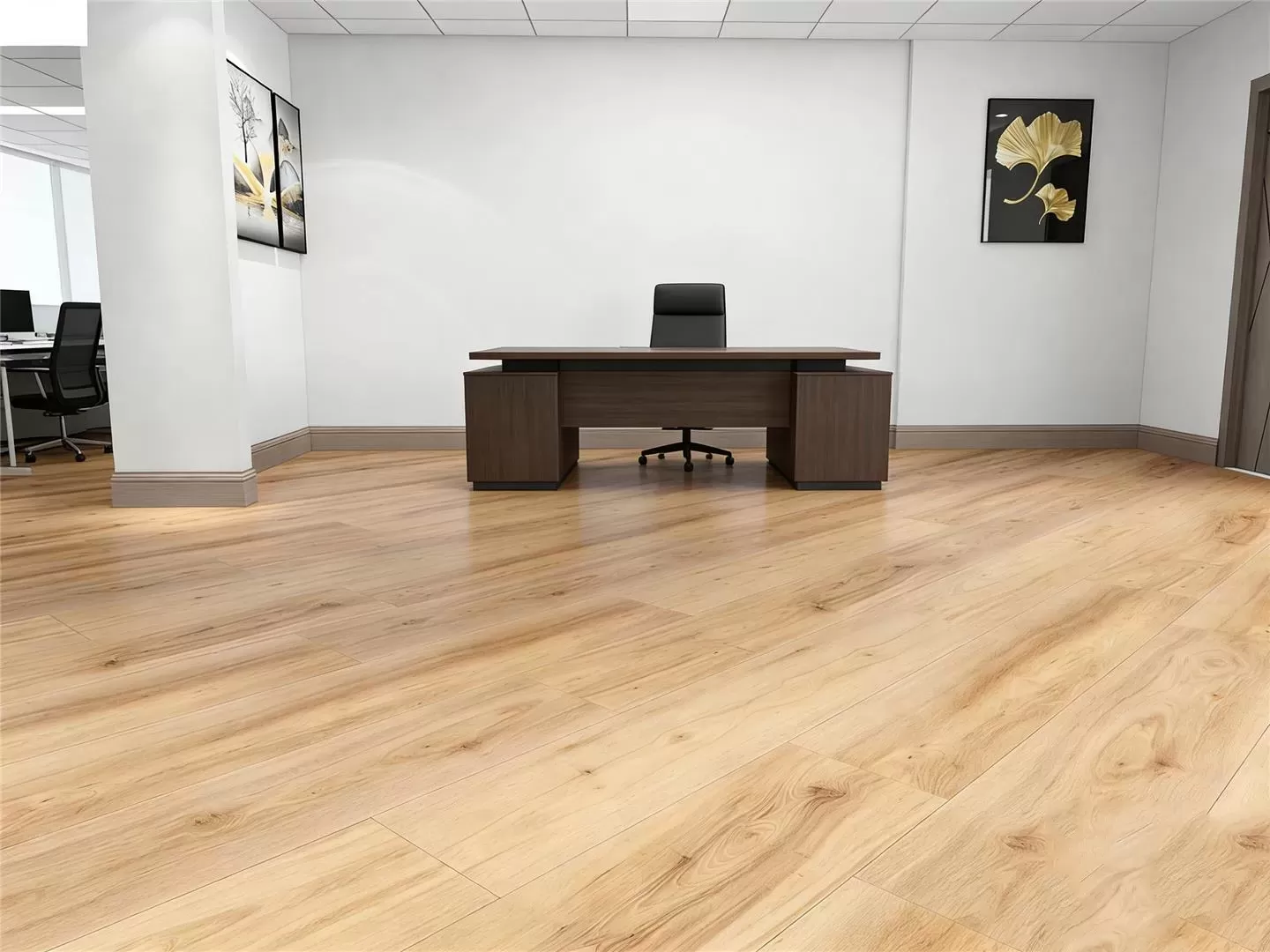
Structural Comparison: SPC vs. Traditional LVT Core Technologies
Under high moisture and temperature fluctuations, the choice of core technology is the most decisive factor in determining floor stability. Luxury Vinyl Tile (LVT) is historically classified into flexible dry-back, loose-lay, and rigid core categories. Flexible LVT consists primarily of polyvinyl chloride (PVC) resins mixed with plasticizers, stabilizers, and fillers. While completely impervious to water, its high plasticizer content makes it susceptible to dimensional changes when exposed to temperature shifts. In bathrooms with direct sunlight or underfloor heating, flexible LVT can expand and contract, leading to joint separation or buckling.
Stone Plastic Composite (SPC) represents a significant advancement in rigid core design. The core formulation consists of approximately 70% to 75% natural calcium carbonate (limestone) combined with PVC and stabilizers, completely eliminating plasticizers. This high mineral content yields a core density typically ranging from 1.9 to 2.1 g/cm³. Consequently, SPC exhibits negligible dimensional movement under thermal stress. The rigid structure also prevents telegraphing, a common issue where minor subfloor imperfections project through to the surface over time.
From a performance perspective, SPC is highly suited for wet areas. The lack of wood fibers, unlike Wood Plastic Composite (WPC) or laminate, prevents water absorption and subsequent swelling. When evaluated under extreme conditions, SPC maintains its shape, ensuring that the interlocking joints remains intact and watertight.
Performance Standards for Waterproof Vinyl Flooring for Bathrooms
Specifying flooring for commercial wet areas requires strict adherence to international safety and durability standards. Slip resistance is the foremost safety parameter in bathroom design, where wet surfaces increase the risk of accidents. Specifiers utilize two primary testing methods: the Pendulum Test Value (PTV) and the DIN 51130 Oil-Wet Ramp Test. For bathroom installations, an R10 rating or a wet pendulum test result of 36+ PTV is typically targeted to ensure adequate traction.
Beyond slip resistance, wear layer thickness dictates the lifespan of the installation in high-traffic commercial environments. The wear layer, a clear PVC film applied over the decorative print layer, is measured in millimeters or mils. For light commercial or multi-family residential bathrooms, a 0.3mm (12 mil) wear layer is standard. High-traffic commercial areas, such as hotel guest bathrooms or public facilities, require a 0.55mm (20 mil) or 0.70mm (28 mil) wear layer. These heavy-duty configurations withstand abrasive cleaning agents, frequent scrubbing, and foot traffic without degrading.
Surface Coatings and Chemical Resistance
To enhance surface durability, manufacturers apply a specialized polyurethane (PU) coating over the wear layer. TAB Flooring utilizes a double-cured UV coating reinforced with microscopic ceramic beads. This additive hardens the surface, preventing micro-scratches that can harbor bacteria and moisture. The chemical resistance of this coating is tested under ASTM F925, ensuring that common bathroom cleaning agents, disinfectants, and personal care products do not stain or degrade the finish.
Dimensional Stability and Indentation Resistance
In addition to surface wear, the floor must withstand static loads from bathroom fixtures, such as heavy vanities or bathtubs. The ASTM F970 standard measures residual indentation under specific loads. High-density SPC flooring demonstrates excellent resistance to static loads, showing minimal indentation compared to softer flexible LVT or cushioned sheet vinyl. This structural integrity prevents permanent marking from heavy bathroom cabinetry.
Joint Profiling and Moisture Ingress Prevention
While the vinyl material itself is hydrophobic, the weakest points of any floor assembly are the seams. If water penetrates the joints, it can pool beneath the flooring, leading to subfloor damage, mold growth, and adhesive failure. To prevent this, precision mechanical profiling is required. Modern click-lock systems, such as Unilin or Valinge profiles, are cut with tolerances measured in micrometers. This tight lock creates a mechanical tension that holds the planks together, preventing surface water from seeping through capillary action.
To supplement tight mechanical tolerances, advanced manufacturing processes allow for the application of hydrophobic sealants to the tongue-and-groove profiles during profile cutting. This wax-based or polymer-based edge coating repels moisture, ensuring that even if water sits on the seam for extended periods, it cannot easily penetrate the joint. This is especially useful in modular bathroom pod manufacturing, where flooring is installed in off-site factories and must withstand transportation and variable storage conditions before building completion.
Sourcing from an experienced manufacturer like TAB Flooring ensures that the click profiles are consistently monitored during production. Laser-guided cutting systems maintain profile accuracy, reducing the risk of height variation between planks (overwood/underwood), which can catch on footwear and lead to premature edge wear or joint damage.
Acoustic Control and Integrated Underlayment Systems
Multi-story multi-family and hospitality projects require acoustic isolation between floors. Impact sound transmission through concrete or wood joist subfloors must be mitigated to meet building codes, achieving specific Impact Insulation Class (IIC) ratings. Traditional installations require separate underlayment membranes, which adds labor steps and cost. Integrated underlayment systems solve this by adhering the backing directly to the SPC plank during production.
The choice of underlayment material directly impacts both acoustic performance and moisture resistance. Irradiated Cross-Linked Polyethylene (IXPE) is the preferred material for high-humidity environments. Unlike traditional cork or open-cell foam backings, IXPE features a closed-cell molecular structure. This structure prevents water absorption, ensuring that the backing does not hold moisture or encourage fungal growth if concrete slab emissions are high. Typical thicknesses range from 1.0mm to 1.5mm, providing sound dampening of up to 20 decibels (dB) in sound transmission tests.
Using an integrated IXPE underlayment also provides minor subfloor compensation. It cushions small irregularities in the subfloor, reducing click-noise and enhancing underfoot comfort. For B2B projects, importing pre-attached IXPE flooring significantly accelerates installation timelines, reducing on-site labor overhead.
Subfloor Preparation and Installation Protocols
Successful installation of rigid core vinyl flooring in bathroom environments requires thorough subfloor assessment. Concrete subfloors must be tested for relative humidity (RH) using in-situ probes according to ASTM F2170. If RH levels exceed 80%, a topical moisture vapor barrier or a continuous polyurethane primer must be applied to prevent hydrostatic pressure from forcing moisture up through the subfloor.
Flatness is another key factor. Although SPC is rigid enough to bridge minor variations, any subfloor unevenness exceeding 3mm over a 3-meter radius must be leveled using self-leveling cementitious compounds. Failure to level the subfloor can put excessive stress on the click-lock joints under heavy rolling loads, leading to joint breakage and subsequent water leakage. The following steps outline the standard protocol for commercial installations:
Subfloor Cleaning: Remove all dust, adhesive residue, paint, and curing compounds from the substrate.
Moisture Testing: Perform ASTM F2170 testing to determine concrete RH levels.
Leveling: Apply cementitious self-leveling underlayment to high or low spots to achieve specified flatness tolerances.
Acclimatization: Store the flooring material in the installation space for 24 to 48 hours to allow the materials to stabilize at operating temperatures.
Expansion Gaps: Maintain an expansion gap of 6mm to 8mm around the perimeter of the bathroom, including walls, pipes, and built-in fixtures, to accommodate minor building movement.
Perimeter Sealing: Use a high-grade 100% silicone sealant to fill expansion gaps around wet areas like tubs and toilets, preventing surface water from bypassing the perimeter.
Why TAB Flooring is the Preferred Partner for OEM Customization
Sourcing flooring for large-scale commercial developments requires a manufacturer that understands both technical specifications and production consistency. TAB Flooring operates as a dedicated OEM and custom manufacturing partner, delivering SPC and LVT solutions tailored to precise project needs. By managing the formulation of the core, the thickness of the wear layer, and the selection of integrated underlayments, we ensure that every square meter meets international performance benchmarks.
Our production facilities utilize state-of-the-art extrusion and profiling equipment, allowing us to maintain tight tolerances and offer custom embossing, wear layers, and dimensions. Whether you are specifying flooring for a multi-family housing portfolio, a national hotel chain, or a healthcare facility, our engineering team provides comprehensive support from sample validation to container-load logistics.
Sourcing and Inquiry Process
When selecting waterproof vinyl flooring for bathrooms, working directly with an experienced manufacturer ensures both product quality and project-specific specifications. TAB Flooring provides direct B2B pricing, custom sample development, and complete documentation for architectural submittals. Contact our technical sales team today to request product specifications, certifications, and volume pricing quotes for your upcoming commercial projects.
Frequently Asked Questions
Q1: Does waterproof vinyl flooring for bathrooms require a separate waterproof membrane underneath?
A1: While the SPC core itself is entirely waterproof, an underlayment is typically required for sound absorption and subfloor leveling. If the subfloor is concrete and exhibits high relative humidity (above 80% RH per ASTM F2170), a 6-mil poly film vapor barrier or a specialized liquid moisture barrier is recommended to protect the surrounding structure and prevent vapor-related issues.
Q2: What is the recommended wear layer thickness for commercial bathroom projects?
A2: For commercial and high-traffic multi-family applications, a wear layer thickness of at least 0.55mm (20 mil) is highly recommended. This provides sufficient resistance to heavy foot traffic, rolling carts, and harsh cleaning disinfectants used in commercial maintenance protocols.
Q3: How does SPC flooring handle underfloor heating systems in wet areas?
A3: SPC flooring has excellent thermal conductivity and is compatible with hydronic or electric underfloor heating systems. However, the heating elements must be embedded in the subfloor, and the surface temperature of the flooring should not exceed 27°C (80°F) to maintain dimensional stability and prevent joint stress.
Q4: Can SPC vinyl planks be installed directly over existing ceramic tiles in a bathroom?
A4: Yes, because of its rigid core construction, SPC can be installed over existing ceramic tiles, provided they are flat, clean, and securely bonded to the subfloor. Any deep grout lines wider than 5mm should be filled with a patch compound prior to installation to prevent telegraphing or locking system compromise.
Q5: How does the slip resistance of SPC vinyl compare to traditional ceramic tiles?
A5: High-quality SPC vinyl can achieve slip resistance ratings equivalent to or better than standard ceramic tiles. By utilizing textured embossing (such as EIR - Embossed in Register) and specialized polyurethane coatings containing ceramic beads, SPC flooring can meet the R10 or 36+ PTV wet pendulum test requirements needed for public and private bathroom environments.