
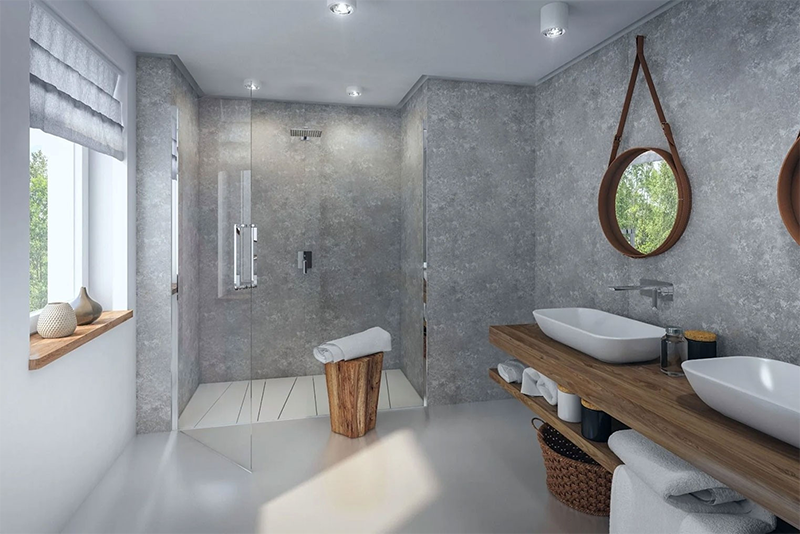
Commercial bathroom design demands materials that balance aesthetic authenticity with severe moisture management. Traditional ceramic, porcelain, and natural stone installations have historically dominated wet areas, yet their structural rigidity, high dead-load weight, extended installation schedules, and brittle grout lines present persistent challenges for multi-family developers and hospitality operators. The evolution of rigid core engineering has positioned bathroom tile vinyl flooring as a primary specification choice for high-moisture interiors, offering the visual weight and texture of mineral tile alongside superior dimensional stability and rapid turnaround capabilities.
Specifying resilient flooring for wet environments requires an understanding of polymer chemistry, core composition, interlocking joint tolerances, and surface coefficient of friction. Selecting the appropriate substrate and wear profile prevents long-term moisture entrapment, subfloor degradation, and premature surface failure.
Core Architecture: SPC vs. LVT in Wet Areas
The operational longevity of resilient tile in bathrooms relies directly on the core formulation. While early generation luxury vinyl tile (LVT) relied on flexible, plasticized polyvinyl chloride layers, current commercial projects predominantly utilize Stone Plastic Composite (SPC) or reinforced mineral-based cores to prevent thermal and moisture-induced dimensional movement.
Rigid Core SPC: Formulated with a high ratio of calcium carbonate (limestone) to PVC polymer (typically 3:1 to 4:1), SPC delivers near-zero thermal expansion and exceptional indentation resistance. The absence of liquid plasticizers eliminates the possibility of plasticizer migration, ensuring that panels remain flat even under sustained ambient humidity shifts.
Traditional Dryback LVT: Flexible virgin PVC planks adhered directly to the slab with waterproof adhesives. While dryback LVT eliminates topical perimeter movement, it transfers subfloor telegraphing rapidly and relies entirely on adhesive film integrity to prevent water seepage into the substrate.
WPC (Wood Plastic Composite): Incorporates foaming agents with wood flour or polymer composites. Though comfortable underfoot, the micro-cellular voids can retain vapor under sustained water immersion, making dense SPC the standard preference for bathroom applications.
Manufacturers like TAB Flooring engineer rigid stone composite matrices engineered specifically to withstand hydrothermal cycling, preventing plank cupping or edge lifting at perimeter interfaces.
Surface Engineering, Wear Layers, and Slip Resistance
Bathroom flooring must provide reliable traction under both dry and wet conditions without creating porous micro-textures that harbor mold, soap scum, or cleaning chemicals. The surface structure of modern bathroom tile vinyl flooring incorporates multiple protective strata to ensure commercial durability and human safety.
Slip resistance standards for wet environments are governed by international testing protocols, including DIN 51130 (ramp testing) and ASTM C1028 / BS 7976-2 (Pendulum Test Values). Specifiers must verify that ceramic-look resilient tiles achieve minimum operational ratings:
R10 to R11 Ratings: Required for commercial restrooms, hospitality guest bathrooms, and assisted living facilities to prevent slip events on wet surfaces.
Pendulum Test Value (PTV) ≥ 36: Indicates a low slip potential under contaminated (water/wet soap) conditions.
Ceramic-Embossed Textures (EIR): Embossed-in-Register technology mimics slate, travertine, or honed marble textures, generating mechanical friction without deep valleys that trap moisture.
The protective wear layer—typically composed of transparent, high-density PVC reinforced with cross-linked polyurethane and ceramic bead or aluminum oxide additives—ranges from 0.55mm (22 mil) for commercial housing to 0.70mm (28 mil) for heavy commercial traffic. This top coat shields the printed decorative film from mechanical abrasion, ultraviolet discoloration from window exposure, and aggressive chemical sanitizers.
Moisture Ingress Mitigation: Joint Geometry and Sealing
Topical water protection is only as robust as the mechanical connection between adjacent tiles. Water penetrating the seams of a floating floor can stagnate over the subfloor, facilitating microbiological growth, degrading underlayment pads, and generating odors.
Modern click profiles engineered for bathroom tile vinyl flooring utilize advanced patented locking designs (such as licensed Unilin or Välinge profiling) cut with strict micron-level tolerances. These profiles generate continuous vertical and horizontal tension across the seam, creating a hydro-tight joint that inhibits surface liquid from penetrating the core under routine commercial maintenance.
Integrated painted micro-bevels or faux-grout channels provide the aesthetic division of traditional ceramic tiles without utilizing cementitious grout. Unlike traditional grout, which requires periodic sealing and is prone to micro-cracking, vinyl tile grout lines are monolithic with the surface wear system or filled with flexible, non-porous polymer compounds that repel water entirely.
Subfloor Interface and Underlayment Integration
The interface between the tile assembly and the structural subfloor requires precise planning regarding moisture vapor emission rates (MVER) and acoustic insulation.
Vapor Barriers: Concrete slabs must be evaluated via ASTM F2170 (in-situ relative humidity testing). Where relative humidity exceeds 85%, a continuous 6-mil polyethylene slip sheet or specialized epoxy moisture mitigation membrane must be placed prior to floating floor placement.
Underlayment Density: High-density closed-cell IXPE (irradiated cross-linked polyethylene) or EVA foam is laminated directly to the core backing. For bathroom applications, IXPE is superior due to its zero-water-absorption rate, anti-microbial properties, and acoustic dampening (achieving high IIC and STC ratings in multi-story construction).
Subfloor Deflection: Subfloors must meet minimum flatness tolerances, generally 3/16 inch over a 10-foot radius. Inadequate subfloor leveling creates dynamic deflection under foot traffic, stressing click-lock joints and compromising seam water-tightness.
Commercial Advantages Over Traditional Ceramic Tile
While ceramic and porcelain have historically been the default materials for wet spaces, commercial procurement data indicates a continuous shift toward rigid core alternatives across high-volume sectors.
Weight reduction represents a major structural benefit. Porcelain tile assemblies average 4.5 to 6 pounds per square foot, excluding mortar bed weight. In contrast, rigid vinyl tile systems weigh approximately 1.8 to 2.2 pounds per square foot. In multi-story modular construction, student housing, and commercial high-rises, this weight reduction reduces overall structural dead load while simplifying logistics and vertical material transport.
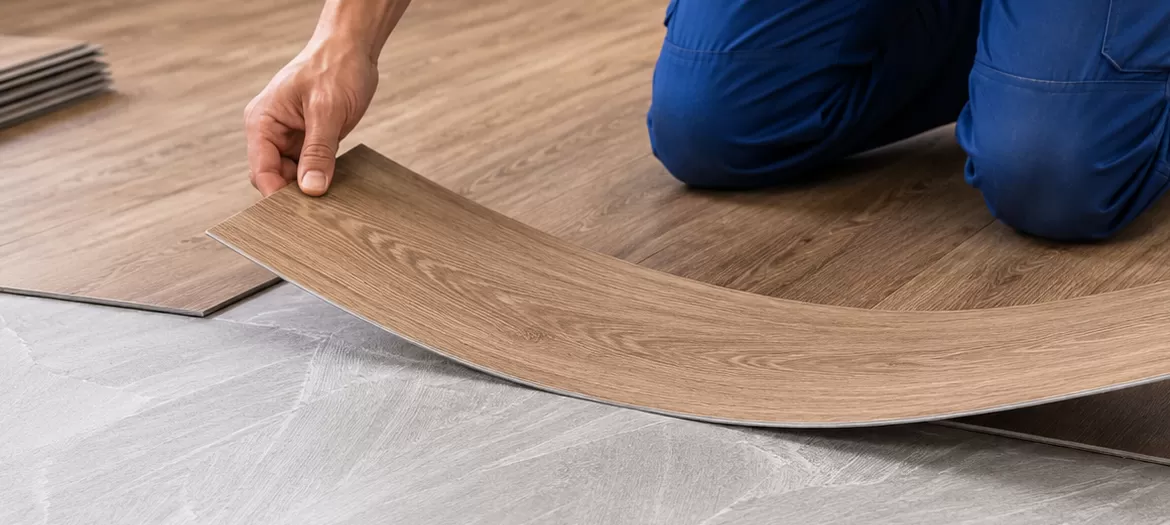
Installation efficiency accelerates operational timelines. Wet trades (thin-set mixing, tile spacing, setting, and subsequent grouting) require multi-day drying phases during which areas remain off-limits to other trades. Floating or direct-stick resilient tiles allow immediate foot traffic post-installation, shortening room turnover cycles in hotel renovations and new commercial builds.
Acoustic performance in multi-family dwellings is inherently superior. Ceramic surfaces reflect sound and transmit impact noise readily to units below, requiring heavy acoustic isolation membranes. Rigid core tiles with pre-attached IXPE backing absorb localized impact vibrations, routinely meeting stringent multi-family building codes without secondary underlayments.
Custom Manufacturing and OEM Sourcing Considerations
Large-scale commercial developments, hospitality chains, and distributors require custom design adaptation, tight batch consistency, and certified compliance. Working with an experienced manufacturing partner like TAB Flooring allows procurement teams to balance dimensional specifications, aesthetic prints, and performance metrics.
When developing an OEM product line for high-moisture commercial environments, several production criteria dictate the quality of the final output:
Virgin vs. Recycled PVC Content: Virgin core stock ensures absolute dimensional stability and uniform density, preventing core brittleness and edge breakage during high-speed precision profiling.
High-Definition Direct Print & Decorative Films: Sourcing high-resolution film layers replicating natural stone, concrete, and terrazzo patterns eliminates repetitive pattern repeats across commercial layouts.
Precision Profile Calibration: Optical profiling sensors during continuous production ensure that interlocking profiles do not deviate, securing long-term water-tightness across millions of square feet.
Environmental Certifications: Sourcing requires FloorScore, GREENGUARD Gold, and CE compliance to verify low volatile organic compound (VOC) emissions, ensuring compliance with LEED criteria for indoor air quality.
Frequently Asked Questions
Is bathroom tile vinyl flooring fully waterproof or merely water-resistant?
Rigid core vinyl tile manufactured with an SPC or virgin PVC formulation is 100% waterproof; the material itself will not swell, rot, or lose structural integrity upon direct exposure to water. However, the installation system must incorporate proper perimeter expansion joints sealed with silicone to prevent standing water from migrating beneath the planks onto porous subfloors.
Can bathroom tile vinyl flooring be installed directly over existing ceramic tile?
Yes, provided the existing ceramic surface is structurally sound, level, and securely bonded to the subfloor. Deep grout lines exceeding 4mm in width or 2mm in depth should be filled with a self-leveling patching compound to prevent joint telegraphing over time, ensuring a smooth substrate for floating click systems.
What wear layer thickness is required for hospitality and multi-family bathrooms?
For residential and light multi-family units, a 0.30mm (12 mil) to 0.55mm (22 mil) wear layer is common. For commercial hospitality, healthcare restrooms, and heavy foot traffic installations, a 0.55mm (22 mil) to 0.70mm (28 mil) wear layer with a ceramic-reinforced UV coating is specified to resist abrasive wear and frequent sanitation procedures.
How does underfloor heating interact with rigid core vinyl in wet areas?
SPC flooring systems can be paired with embedded hydronic or electric radiant heating systems. The operating surface temperature must not exceed manufacturer thresholds (typically 27°C or 80°F). The low thermal resistance of stone composite materials allows efficient heat transfer while maintaining dimensional stability.
How should perimeter expansion gaps be handled in commercial bathroom installations?
A perimeter expansion gap of approximately 6mm to 8mm must be maintained along all vertical walls and fixtures. In wet areas, this gap should be concealed using color-matched waterproof PVC or aluminum skirting, with a flexible commercial silicone sealant bead applied at the floor-to-wall interface to block water ingress around edges.
For custom production runs, project specifications, and sample requests regarding high-performance resilient tile products, contact the technical sales and OEM team directly via email at admin@flooringmanufacture.com to discuss your commercial project requirements.