
Commercial construction projects demand flooring systems that balance aesthetic appeal with long-term structural integrity. Among the various options available, Luxury Vinyl Tile (LVT) and Stone Plastic Composite (SPC) flooring have become industry standards due to their durability, water resistance, and rapid installation timelines. However, the performance of these materials depends heavily on the quality of the installation process. When laying vinyl plank flooring in multi-family housing, hospitality venues, or healthcare facilities, understanding subfloor dynamics and material characteristics is the first step toward preventing failures such as joint separation, buckling, and telegraphing.
For architects, general contractors, and procurement managers, partnering with a dependable manufacturer like TAB Flooring ensures access to high-specification materials. Yet, even the highest-grade SPC or LVT requires precise execution during the installation phase. This article analyzes the detailed engineering requirements, preparation protocols, and step-by-step methodologies necessary to achieve a stable, high-performing floor system.
Subfloor Assessment: The Foundation of Resilient Installations
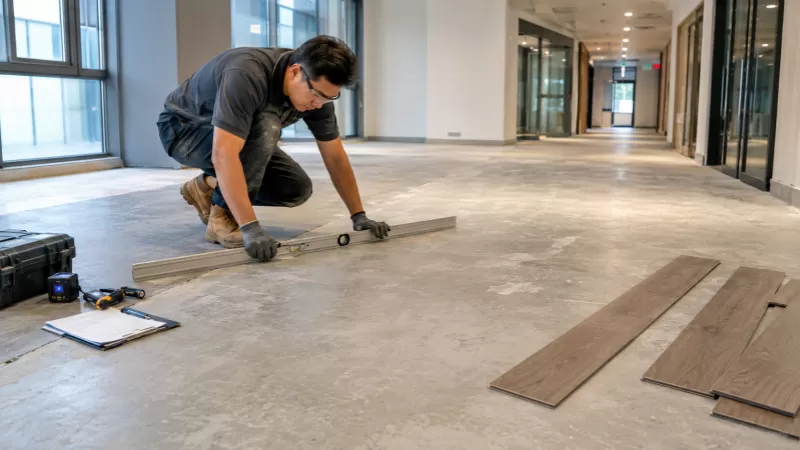
A vinyl floor installation is only as reliable as the substrate beneath it. The vast majority of post-installation failures stem directly from inadequate subfloor preparation. Before laying vinyl plank flooring, the subfloor must be thoroughly evaluated for flatness, moisture content, and structural integrity.
Concrete Substrates and Moisture Management
Concrete slabs must be fully cured, typically requiring a minimum of 28 days after pouring, and must undergo rigorous moisture testing. Resilient flooring manufacturers and industry standards dictate two primary testing methods:
ASTM F2170 (In-Situ Relative Humidity): This test measures the relative humidity (RH) within the concrete slab using smart probes. For standard installations, the RH level should not exceed 85% to 90%, unless specialized high-moisture adhesives or vapor barriers are utilized.
ASTM F1869 (Calcium Chloride Test): This measures the moisture vapor emission rate (MVER). The emissions should generally be below 3 to 5 lbs per 1,000 square feet per 24 hours.
High moisture levels lead to alkaline accumulation at the surface, which can degrade adhesives or foster sub-floor microbial growth. If moisture levels exceed the recommended thresholds, a concrete moisture vapor barrier or an epoxy-based mitigation system must be applied before proceeding.
Subfloor Flatness and Surface Prep
According to ASTM F710 standards, the subfloor must be clean, dry, and flat to within 3/16 of an inch over a 10-foot radius (or 1/8 of an inch over 6 feet). Any deviations beyond this tolerance will compromise the locking mechanisms of SPC or LVT planks, leading to eventual joint fatigue and separation under rolling loads.
High Spots: Concrete ridges, trowel marks, or old adhesive residues must be mechanically ground down.
Low Spots: Depressions, cracks, and control joints must be filled using a high-compressive-strength, Portland cement-based patching compound or self-leveling underlayment. Gypsum-based compounds are generally discouraged in commercial settings due to lower shear strength.
Wood Subfloors: For plywood or OSB substrates, ensure the panels are APA-rated underlayment grade, with a minimum thickness of 1 inch. The subfloor must be structurally sound with no deflection. Secure any loose panels with screws to eliminate squeaks and movement.
Environmental Conditioning and Acclimation Protocols
Even though rigid core SPC flooring exhibits excellent dimensional stability due to its high calcium carbonate (stone) content, temperature and humidity fluctuations during installation can still impact the polymer components of the core and wear layers.
Thermal Expansion and Polymer Behavior
Polyvinyl chloride (PVC) is susceptible to thermal expansion and contraction. If planks are installed immediately after transport from a cold warehouse or a hot delivery vehicle, they will adjust to the building's operating temperature post-installation. This adjustment leads to pressure buildup (causing buckling) or shrinkage (causing joint gaps).
Ambient Temperature and Humidity Control
To mitigate this, the installation space must be climate-controlled. The HVAC system should be operational and set to a temperature range between 65°F and 85°F (18°C to 29°C) for at least 48 hours before, during, and after laying vinyl plank flooring. The relative humidity of the space should ideally remain between 35% and 65%. Planks must be stored flat, out of direct sunlight, and in small stacks to allow uniform airflow and temperature equalization across all boxes.
Material Selection: Balancing Core Structure and Underlayment Performance
Selecting the appropriate core construction—whether flexible LVT or rigid SPC—and matching it with the correct underlayment is vital for meeting commercial building codes, especially regarding acoustic performance.
| Property | Flexible LVT (Glue-Down/Loose Lay) | Rigid Core SPC (Click-Lock) |
|---|---|---|
| Core Composition | PVC polymer with plasticizers | PVC polymer with stone dust (CaCO3) |
| Dimensional Stability | Moderate (susceptible to temperature) | Excellent (highly stable) |
| Telegraphing Resistance | Low (requires highly smooth subfloor) | High (bridges minor subfloor gaps) |
| Acoustic Performance | Depends on glue type and underlayment | Often features pre-attached IXPE backing |
Acoustic Performance Metrics (IIC and STC)
In multi-family residential structures, localized building codes often mandate specific Impact Insulation Class (IIC) and Sound Transmission Class (STC) ratings. Many SPC options from TAB Flooring come equipped with an integrated IXPE (irradiation-crosslinked polyethylene) or EVA underlayment. If an additional underlayment is used, it must be highly dense (typically under 1.5mm thick with a high density rating) to prevent deflection. An underlayment that is too thick or too soft will allow too much vertical movement, putting excessive strain on the click-lock joints and causing them to snap under heavy foot traffic or heavy furniture.
Step-by-Step Execution Guide for Laying Vinyl Plank Flooring
Executing the installation with precision ensures the flooring performs well throughout its intended life cycle. Below is the standard commercial process for laying vinyl plank flooring using a floating click-lock system.
1. Layout Planning and Centerline Calculation
Before opening the first box of flooring, plan the layout to avoid narrow plank widths at the perimeter walls. Measure the width of the room and divide it by the width of a single plank. If the remaining fraction is less than 2 inches (50mm), adjust the starting row's width to balance the room. This ensures that both the starting and ending rows have a balanced visual appearance and structural stability.
2. Establishing the First Row and Maintaining Expansion Gaps
Because buildings settle and materials shift, a continuous expansion gap must be maintained around the entire perimeter of the room, as well as around any vertical obstructions (such as columns, pipes, and door frames).
Place spacers along the starting wall to maintain a consistent gap of 1/4 inch to 5/16 inch (6mm to 8mm).
Lay the first row of planks with the tongue side facing the wall. Ensure the planks are aligned in a straight line; any deviation in the first row will compound across the entire room.
3. Staggering Joints and Row Assembly
To ensure structural integrity and a natural aesthetic, plank end joints must be staggered from row to row. The minimum stagger distance should be no less than 8 inches (200mm). Avoid "H-joints" (where end joints align every second row) or stair-step patterns, which weaken the locking system across the floor plane.
4. Engaging the Click-Profile System
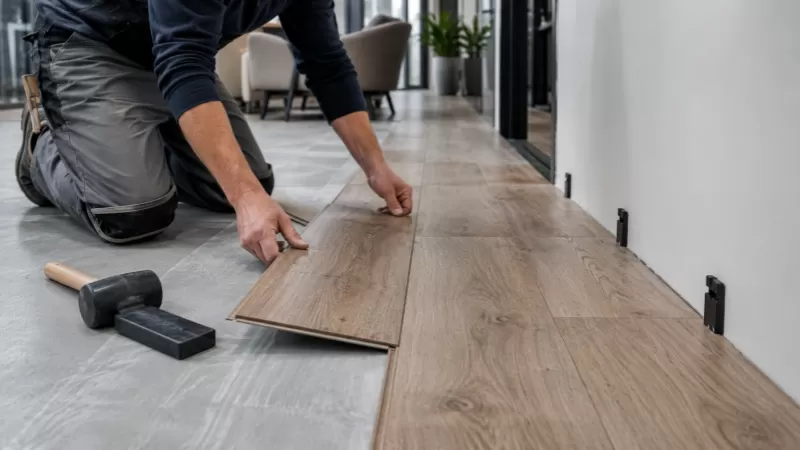
Modern rigid core planks utilize high-precision locking profiles (such as drop-lock or angle-angle designs). When laying vinyl plank flooring, insert the long tongue of the plank into the groove of the installed row at an angle of roughly 15 to 20 degrees, then lower it flat.
Using a resilient-flooring tapping block and a soft-faced deadblown mallet, gently tap the long edge to ensure a tight, seamless fit. Never strike the tongue or groove of the plank directly with a hammer, as this will fracture the locking mechanism and cause the joint to fail prematurely.
Resolving Common Commercial Installation Challenges
Commercial job sites present unique environments where temperature, humidity, and physical layout pose significant challenges to resilient flooring systems. Addressing these variables beforehand prevents costly remediation work.
Subfloor Telegraphing Mitigation
Telegraphing occurs when imperfections, grit, or trowel ridges from the subfloor show through the surface of flexible LVT. While rigid core SPC is highly resistant to this phenomenon, thin flexible LVT acts like a skin over the subfloor. To mitigate this risk, floor prep must include extensive sweeping, vacuuming, and the application of a high-quality skim coat over any porous or irregular concrete substrates.
Managing High Solar Exposure Zones
Large storefront windows, skylights, and southern-facing glazing can raise floor temperatures to over 120°F (49°C) via solar heat gain. In these localized zones, traditional floating vinyl floors are prone to localized expansion and buckling.
For areas exposed to direct sunlight, a heavy-duty, wet-set adhesive should be used to lock the vinyl planks firmly to the substrate, preventing thermal movement. Alternatively, select high-density SPC planks from TAB Flooring, which are specifically formulated with a high calcium-carbonate-to-PVC ratio to withstand higher thermal thresholds.
Adhesive Selection and Plasticizer Migration
In glue-down LVT installations, using the correct adhesive is paramount. Acrylic-based adhesives with high plasticizer resistance must be utilized. Over time, plasticizers within the vinyl can migrate into standard adhesives, softening the bond and causing the planks to shift, curl, or slide. Always verify adhesive compatibility with the manufacturer's technical data sheets.
Post-Installation Protection and Quality Control
The phase between flooring installation and final building handover is when the floor is at its highest risk of physical damage from other trades (such as drywallers, painters, and electricians).
Curing Time: If a glue-down system was installed, restrict foot traffic for at least 24 hours and heavy rolling loads for 48 to 72 hours to allow the adhesive to fully cure.
Physical Barriers: Cover the newly installed floor with thick, non-staining construction paper or protective Masonite boards. Avoid using adhesive tapes directly on the polyurethane wear layer of the flooring, as the tape adhesive can react with the factory finish, leaving residues or causing discoloration.
Initial Maintenance: Before handover, sweep or vacuum the floor to remove construction dust and grit. Clean with a neutral pH resilient floor cleaner; avoid using abrasive scrubbers, black pads, or harsh chemicals that can scratch or dull the wear layer.
Custom Manufacturing and B2B Partnership with TAB Flooring
For large-scale commercial developments, standardized, off-the-shelf flooring often falls short of specific engineering, acoustic, or aesthetic requirements. Partnering with TAB Flooring provides developers and contractors with customized solutions tailored to specific commercial projects.
TAB Flooring offers customizable wear layer thicknesses (ranging from 0.3mm for light commercial to 0.7mm for high-traffic environments), variable overall thicknesses, integrated acoustic underlayments, and advanced polyurethane coatings with ceramic bead technology for enhanced scratch resistance. Our technical support team works closely with project planners to ensure that the material delivered aligns with the structural demands and environmental conditions of the site, facilitating a smooth installation process.
To receive detailed product specifications, custom pricing structures, or physical samples for your next commercial project, please submit an inquiry to our technical sales team. We are prepared to assist with your material selection, acoustic subfloor designs, and high-volume procurement schedules.
Frequently Asked Questions
Q1: Can laying vinyl plank flooring be done directly over existing ceramic tile?
A1: Yes, but only if the ceramic tile is structurally sound, fully bonded to the substrate, and flat. The grout lines must be filled with a Portland cement-based patching compound to make them flush with the tile surface. This prevents the grout line pattern from telegraphing through flexible vinyl or causing instability in the click-lock joints of rigid core SPC.
Q2: What is the maximum run length allowed before a transition molding is required?
A2: For standard floating LVT, transition moldings are typically required in doorways and for continuous runs exceeding 50 linear feet (15 meters). For high-density rigid core SPC from TAB Flooring, the maximum continuous run can often extend up to 100 linear feet (30 meters) without transitions, provided the room has consistent temperature controls and adequate perimeter expansion gaps.
Q3: How do we handle heavy fixtures, such as kitchen islands or commercial display cases, on a floating floor?
A3: Floating floors must be free to expand and contract. Heavy fixtures weighing several hundred pounds should never be installed directly on top of a floating floor, as this pins the floor down, preventing movement and leading to buckling or joint failure. Instead, install the fixtures first, then cut and fit the floating floor around them, maintaining the proper expansion gap beneath the toe kicks or trim.
Q4: Why is a concrete relative humidity of 95% problematic, and how can we address it?
A4: A relative humidity of 95% indicates high moisture vapor emission. This level can break down standard flooring adhesives, cause mold growth beneath the planks, or push soluble salts to the surface (efflorescence), which can damage the backing of the flooring. To address this, apply a certified epoxy moisture mitigation barrier that meets ASTM F3010 standards before installing the flooring.
Q5: Can laying vinyl plank flooring be done over radiant heating systems?
A5: Yes, vinyl planks can be installed over hydronic or electric in-floor radiant heating systems, provided the heating elements are embedded in concrete or a self-leveling underlayment. The floor surface temperature must never exceed 85°F (29°C), and the heating system should be turned off or set to a low level during the installation process to prevent rapid adhesive drying or localized thermal expansion.