The global luxury vinyl tile (LVT) market is undergoing a fundamental shift in 2026. Installation techniques, material science, and project delivery models are evolving at a rapid pace. At TAB Flooring, we have spent years observing where projects succeed and where they fail. A clear pattern has emerged. Most failures and after-sales disputes do not originate from product quality issues. Instead, they trace back to poor decision-making during the pre-installation selection phase.
This article stands at the intersection of custom flooring manufacturing and professional installation advisory. We will walk you through the critical elements of installing luxury vinyl tile in 2026 — from product selection and system comparison to specification verification and packaging logistics. Our goal is straightforward. We want to help you reduce risk, control costs, and deliver successful projects at every step.
1、Three Core Decisions Before Installing Luxury Vinyl Tile
1.1 Selection by Application Scenario
One of the most common mistakes we encounter at TAB Flooring is the "one product fits all" approach. The reality is different. Proper LVT selection must follow the specific demands of each application environment.
Here is how we recommend matching product lines to scenarios:
Residential interiors: LVT Click systems. These prioritize comfort, acoustic performance, and DIY-friendly installation.
Commercial high-traffic areas: SPC with a thick wear layer. This combination delivers impact resistance, scratch protection, and easy maintenance.
Wet or humid zones: SPC waterproof cores. These offer excellent dimensional stability and zero expansion under moisture exposure.
Old or uneven substrates: Loose-Lay systems. These tolerate imperfect subfloors and enable rapid renovation with minimal preparation.
Each scenario demands a distinct product architecture. Ignoring this distinction often leads to premature wear, installation failures, and unhappy end-users. We see this pattern repeatedly across our export markets.
1.2 Selection by Installation Method
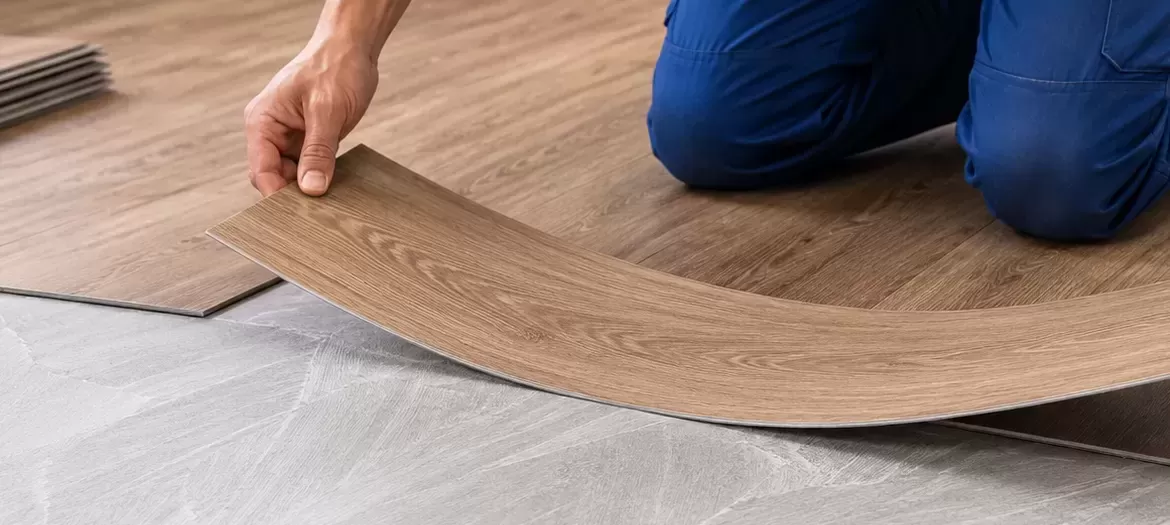
TAB Flooring supplies three primary installation systems. Each suits different project requirements and site conditions.
Click (Locking System)
Floating installation that does
not damage the substrate. This method works well for projects that demand fast
delivery and clean execution. Replacing individual planks remains simple, which
lowers long-term maintenance costs.
Dry-Back (Glue-Down System)
Full-surface adhesive
application provides a permanent, fixed installation. This is the preferred
choice for high-traffic commercial spaces and heavy-load areas. However, it
requires the strictest substrate flatness standards.
Loose-Lay System
Relies on product weight and friction
from the backing to stay in place. This is an excellent solution for renovation
projects where substrate conditions are less than ideal. Installation speed is
the fastest among the three, and plank replacement is effortless.
Choosing the right installation method directly affects project timelines, labor costs, and long-term performance. We advise our clients to evaluate substrate conditions and traffic expectations before making this call.
1.3 Critical Specification Verification — The Dividing Line Between Installation Success and After-Sales Claims
Through years of export experience, TAB Flooring has identified three specifications that consistently determine installation outcomes and warranty responsibilities. Pay close attention to these numbers before placing your order.
Wear Layer Thickness
Residential applications: 0.3mm
minimum.
Commercial applications: 0.55mm or higher.
TAB Flooring's
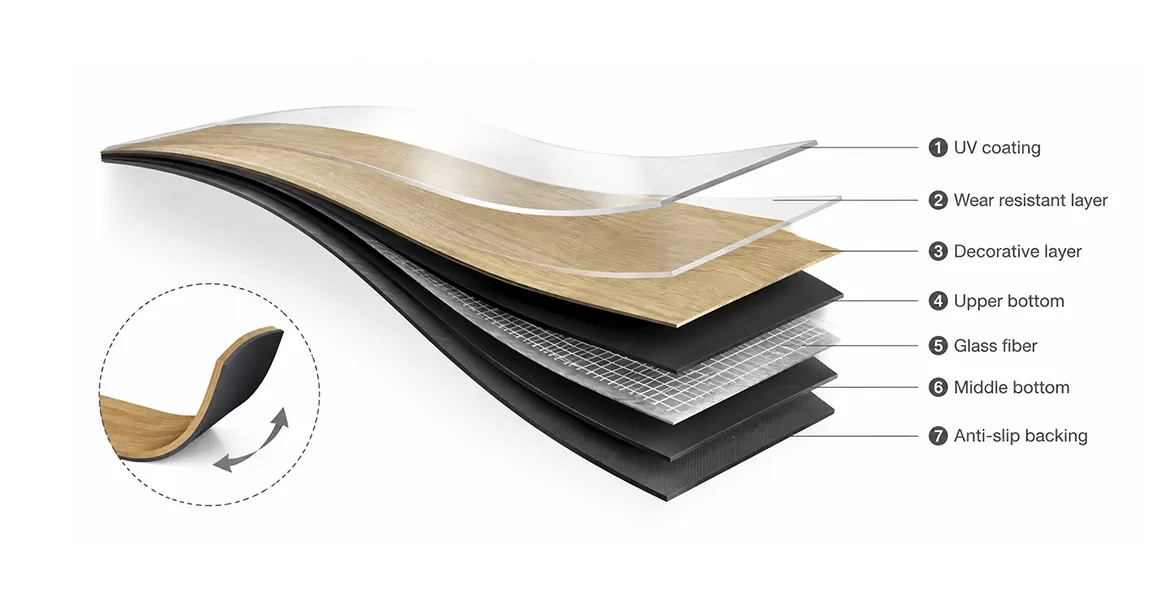
patented bottom wear layer design (0.15mm) delivers twice the dimensional
stability compared to standard constructions.
Total Thickness and Dimensional Stability
SPC core:
dimensional change rate below 0.1% (80°C, 6 hours).
Extruded LVT: dimensional
change rate below 0.15% (80°C, 6 hours).
Heat-pressed LVT: dimensional change
rate above 0.25% — this is where curling risks emerge.
Locking System Strength
Joint stability over the long
term depends directly on the tensile strength of the locking mechanism. Always
request fatigue test reports from your supplier. This documentation provides
real evidence of performance under repeated stress.
These three specifications are non-negotiable checkpoints. They separate professional installations from costly failures.
2、TAB Flooring's Process Advantage — Why Extrusion Outperforms Heat-Press Methods
In 2026, the industry is gradually shifting from traditional heat-press processes to extrusion technology. TAB Flooring adopted consistent LVT extrusion from day one. This choice delivers tangible differences that our clients notice immediately.
Let us compare the two processes directly:
Thickness tolerance: Extrusion (TAB) achieves ±0.05mm, while heat-press methods manage only ±0.15mm.
Dimensional stability: Extrusion delivers superior performance. Heat-press methods offer only average stability.
Batch consistency: Extrusion ensures high uniformity across production runs. Heat-press processes show noticeable variation.
Production cost: Extrusion is 5% more cost-effective. This saving directly translates into competitive pricing and improved margins for our partners.
Curling risk: Extrusion reduces curling to negligible levels. Heat-press products carry a persistent curling risk.
That 5% cost advantage is not just a number. It represents real value for our clients — better pricing without compromising quality. It also provides a safety margin that protects against unforeseen site conditions.
For distributors and project contractors, this consistency means fewer surprises during installation. Fewer surprises translate to fewer service calls and stronger client relationships.
3、2026 LVT Installation Practical Guidelines
3.1 Substrate Preparation — The First Line of Defense
No matter which installation system you choose, substrate preparation remains the decisive first step. We cannot emphasize this enough. A poorly prepared subfloor will undermine even the highest quality LVT product.
Here are the acceptance standards we recommend:
Flatness: 2mm over 2 meters (Click systems require even stricter tolerance).
Moisture content: Below 2.5% for cementitious substrates.
Strength: Pull-off strength不低于 1.2 MPa.
Cleanliness: No oil, wax, grease, or loose particles.
Deviations from these standards will create problems. We have seen countless installations fail because these basic requirements were ignored. Invest the time in substrate preparation. It pays back many times over.
3.2 Environmental Acclimation
The 2026 industry consensus on acclimation is clear:
SPC products: 12 to 24 hours of acclimation is sufficient.
LVT products: Allow 48 hours or more.
On-site temperature and humidity: Maintain 18-24°C with relative humidity between 35% and 65%.
Acclimation allows the flooring to adjust to the installation environment. Skipping this step or rushing it invites expansion, contraction, and gapping issues after installation. We recommend documenting acclimation conditions as part of your quality control process.
3.3 Installation Direction and Layout
Small decisions in layout can have a large visual impact. Here are two practical rules we follow:
Install planks parallel to the direction of natural light entering the room. This creates a sense of spatial extension.
Maintain a staggered joint pattern with offset distance at least one-third of the plank width.
Reserve expansion gaps of 8-10mm along walls and fixed objects.
These guidelines apply across all installation systems. They ensure visual consistency and accommodate natural material movement over time.
3.4 Operational Differences Across Installation Systems
Click System Essentials:
Pay attention to tapping force.
Excessive force damages the locking mechanism. Use dedicated installation
accessories such as tapping blocks and pull bars. These tools prevent edge
damage and ensure proper engagement of the locking profile.
Dry-Back System Essentials:
We recommend two-component
polyurethane adhesives for this method. Control the open time within 15 to 20
minutes. Use a roller to ensure full adhesive contact across the entire plank
surface. Incomplete coverage leads to hollow spots and eventual bond
failure.
Loose-Lay System Essentials:
This system relies on
product weight — typically 3.5 kg per square meter or more. Use double-sided
tape at the perimeter for additional hold. After installation, place heavy
objects on the floor for 24 hours before allowing foot traffic. This helps the
planks settle into position.
4、Complementary Products and Total Solutions
TAB Flooring does not stop at LVT and SPC flooring. We support complete interior solutions.
Our product portfolio includes:
Wall panels: Achieve visual consistency between floors and vertical surfaces.
Outdoor products: Match site types, aesthetic preferences, and project quantities with appropriate exterior-grade options.
Doors and accessories: Reduce coordination overhead by sourcing all components from one partner.
For projects that demand uniform interior wall finishes and practical installation support, TAB Flooring provides a complete system solution. This integrated approach simplifies procurement, reduces logistical complexity, and ensures compatibility across all installed elements.
5、Pre-Installation Preparation for Export Markets
As an export-focused manufacturer, TAB Flooring understands the distinct requirements of different destination markets. Preparing for an international shipment involves more than just loading containers.
5.1 Packaging Solutions
We confirm packaging specifications based on the destination market's unique requirements. Custom packaging for distributors and private-label clients is part of our standard service. Sample support accelerates project approvals and reduces decision-making friction.
Here is what we consider during packaging design:
Protection against moisture and physical damage during transit.
Labeling that meets local regulatory standards.
Unit quantities that align with typical project sizes in the target market.
5.2 Shipping Planning
From product selection and sample confirmation to packing and shipping logistics, we assist clients in preparing practical order plans. This includes:
Coordinating production schedules with shipping windows.
Advising on container loading configurations to maximize space and minimize damage.
Providing shipment tracking and documentation support.
5.3 Documentation Readiness
We help clients prepare all necessary project documentation according to destination market requirements. This ensures smooth customs clearance and hassle-free installation Acceptance. Complete documentation also protects against disputes by providing clear reference points for quality and specification compliance.
Pre-quotation checklist:
Product selection (SPC/LVT/wall panels/outdoor/doors).
Surface texture and color specifications.
Packaging specifications and labeling requirements.
Destination customs and compliance requirements.
Installation tools and accessory list.
Addressing these items before quoting saves time and prevents costly changes later in the process.
From Installer to Solutions Advisor
Installing luxury vinyl tile in 2026 goes far beyond laying planks on a floor. Professional responsibility now spans the entire project lifecycle — from pre-installation product selection and specification verification to on-site substrate treatment, system matching, and post-installation maintenance guidance.
At TAB Flooring, we remain committed to providing export-ready product lines. Our consistent extrusion process, verifiable specifications, and complete supporting systems help global clients achieve lower installation risk, fewer after-sales claims, and higher customer satisfaction.
Whether you are a distributor, private-label operator, or project general contractor, TAB Flooring stands ready to assist. We work alongside you from product selection to shipping planning, helping you prepare practical order solutions that protect your margins and reputation.
We believe that knowledgeable partners build lasting businesses. Our team brings decades of practical experience to every conversation. We do not just supply flooring. We provide the technical backing that turns installing luxury vinyl tile into a predictable, profitable process for your organization.
Frequently Asked Questions
Q1: What is the most important factor to consider before installing
luxury vinyl tile?
A1: Substrate condition is the single most
critical factor. Even the highest-quality LVT will fail if the subfloor lacks
proper flatness, dryness, and cleanliness. We recommend measuring flatness
(2mm/2m), moisture content (below 2.5%), and pull-off strength (above 1.2 MPa)
before any installation begins. These measurements provide objective data for
decision-making.
Q2: How do I choose between Click, Dry-Back, and Loose-Lay systems
for my project?
A2: The choice depends on three variables: traffic
level, substrate condition, and project timeline. Click systems suit residential
and light commercial spaces with good subfloors. Dry-Back works best for
high-traffic commercial areas with flat substrates. Loose-Lay is ideal for
renovation projects where substrate preparation is limited and rapid
installation is required. Evaluate each factor against your specific project
conditions.
Q3: What substrate conditions are required for a successful LVT
installation?
A3: Your substrate must meet four key standards:
flatness within 2mm over 2 meters, moisture content below 2.5% for cement bases,
pull-off strength exceeding 1.2 MPa, and complete freedom from oil, wax, and
loose debris. Deviations from these standards will compromise adhesive bond and
locking system performance. Always test before installation.
Q4: How does TAB Flooring's extrusion process differ from traditional
heat-press methods?
A4: TAB Flooring uses a consistent extrusion
process that delivers tighter thickness tolerance (±0.05mm vs. ±0.15mm),
superior dimensional stability, better batch-to-batch consistency, and 5% lower
production costs. Extrusion also reduces curling risk to negligible levels.
These advantages translate to fewer installation issues and stronger product
performance over time.
Q5: What documentation is needed when exporting LVT products to
international markets?
A5: Export documentation typically includes
product specifications, test reports (dimensional stability, wear layer, locking
strength), customs declarations, and installation guidelines. Destination
markets may also require specific certifications or labeling. TAB Flooring
assists clients in preparing complete documentation packages that support smooth
customs clearance and professional installation Acceptance.
Ready to reduce your installation risk?
Contact TAB Flooring today. Let us help you select the right LVT system for your next project. Our team provides technical guidance, sample support, and complete export documentation. Send us your project requirements, and we will respond with a detailed proposal that protects your margins and ensures successful installation.
Send your inquiry now — we are here to support your business growth.