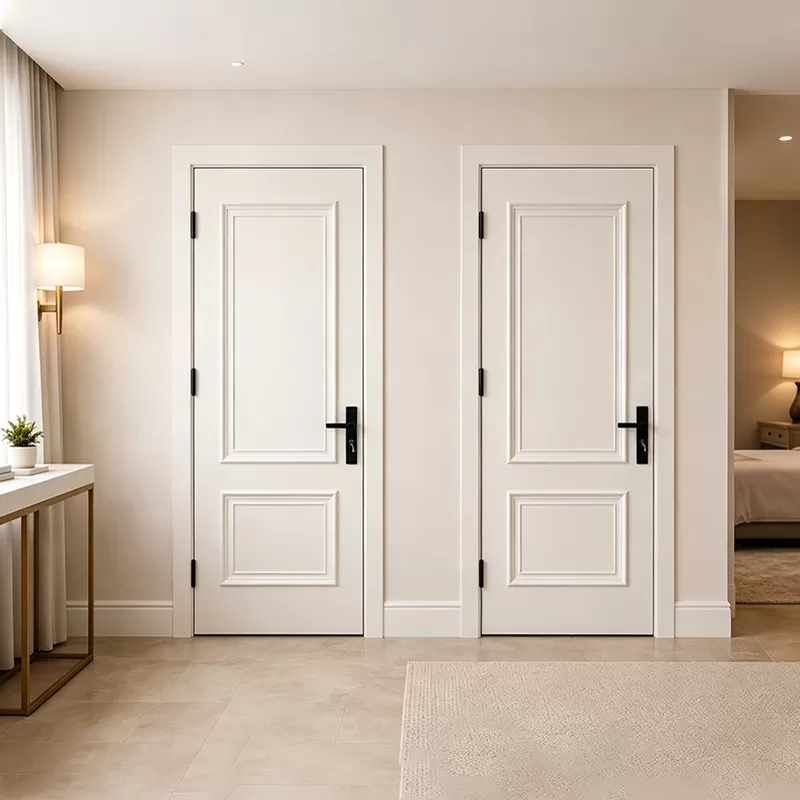
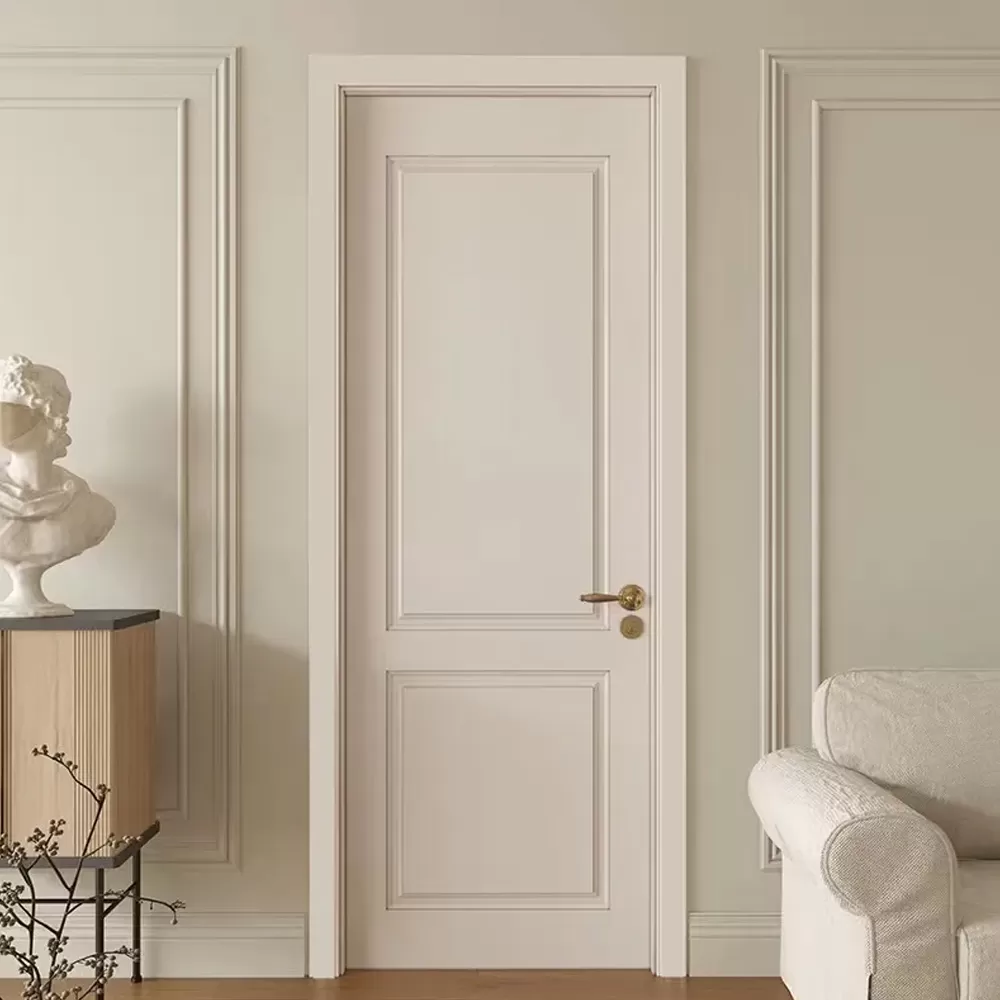
Neutral tones in contemporary interior architecture have shifted from peripheral accents to primary structural statements. Within high-density residential towers, hospitality developments, and commercial headquarters, grey painted interior doors provide visual stability without the stark clinical impression of pure white or the heavy visual weight of dark timber stains. Specifying these assemblies requires an understanding of substrate mechanics, coating chemistry, environmental durability, and precision millwork integration. Selecting the correct door specification guarantees that aesthetic uniformity is maintained across extensive production volumes while meeting strict life-safety, acoustic, and operational lifecycle metrics.
Substrate Engineering and Core Constructions
The structural longevity of any painted door assembly depends on the dimensional stability of its inner core. Solid timber stiles and rails expand and contract along tangential and radial planes in response to ambient relative humidity changes. When applied to solid wood, continuous paint films experience tension and compression forces that inevitably lead to micro-fissuring, joint telegraphing, and hairline cracks at the rail-to-stile junctions. For this reason, professional architectural specifications rely on engineered core solutions engineered to resist hygrothermal deflection.
Solid core doors utilize several distinct inner materials based on performance requirements:
- High-Density Particleboard Core (LD-2 or LD-1): Manufactured from wood particles bonded with thermosetting synthetic resins. This composition provides exceptional surface flatness and uniform density, preventing surface waviness under high-gloss or semi-gloss finishes. It offers excellent screw-holding capacity for architectural hinges and overhead closers.
- Structural Composite Lumber (SCL): Composed of oriented strands or veneers pressed with structural adhesives. SCL is specified when maximum resistance to warp, bow, and twist is required, making it the preferred core for doors exceeding 2400 mm in height.
- Mineral Fire Cores: Inorganic, non-combustible formulations composed primarily of calcium silicate and perlite. These assemblies are mandated for openings demanding 45-, 60-, or 90-minute fire ratings under UL 10C or BS 476 standards.
- Tubular Particleboard: Designed with parallel longitudinal hollows, offering a lightweight profile that reduces hinge stress while providing structural integrity superior to standard honeycomb paper cores.
Engineered core panels are faced with high-density fiberboard (HDF) or medium-density fiberboard (MDF) skins ranging from 3.0 mm to 6.0 mm in thickness. The homogeneous structure of HDF eliminates natural grain patterns, knots, and directional density variations. This uniform substrate provides a surface capable of taking ultra-smooth primers without grain raise, making it an ideal substrate for architectural grey painted interior doors designed for high-traffic installations.
Coating Technologies, Chemistry, and Industrial Finishing
The formulation and application of the paint layer determine a door panel's resistance to abrasion, chemical cleaning agents, and ultraviolet yellowing. Field-applied architectural coatings rarely match the chemical resistance and visual uniformity achieved via factory-controlled industrial finishes.
Coating Systems and Chemical Formulations
Commercial door manufacturing relies primarily on two advanced finishing chemistries:
- Polyurethane (PU) Acrylic Coatings: Formulated through the cross-linking reaction of hydroxyl-functional acrylic resins with aliphatic polyisocyanates. Two-pack (2K) PU coatings yield exceptional chemical resistance, elasticity, and impact durability. The aliphatic chemistry prevents yellowing or shifts in grey chromaticity caused by indoor UV light or ambient sunlight.
- UV-Curable Roller and Spray Finishes: Formulations that polymerize instantaneously when exposed to focused ultraviolet radiation. UV lines produce extremely hard surfaces with near-zero volatile organic compound (VOC) emissions, curing to maximum hardness without extended off-gassing periods.
- Waterborne Industrial Coatings: Utilizing self-crosslinking acrylic emulsions or polyurethane dispersions (PUDs). Modern waterborne formulations meet strict environmental certification criteria (such as LEED v4 and WELL Building Standard) while providing scratch resistance comparable to solvent-borne products.
Advanced manufacturing setups, including lines operated by YAHE LN, implement multi-stage automated finish lines. Automated sanding heads prepare the HDF substrate with progressive grits (P180 through P320). Dust removal systems clear the surface prior to entering positive-pressure, climate-controlled spray chambers. Following primer application, intermediate denibbing removes raised fibers before topcoats are applied. This guarantees a consistent dry film thickness (DFT) between 90 and 130 microns, eliminating orange peel textures, solvent pop, and perimeter sags.
Color Metrics and Sheen Calibration
Grey is an inherently complex chromatic choice due to its sensitivity to spectral reflectance and surrounding lighting conditions. Industrial door manufacturing uses spectrophotometric measurement based on the CIE L*a*b* color space to maintain batch-to-batch consistency. Grey finishes are categorized by their underlying undertones:
- Cool Greys: Characterized by subtle blue, green, or violet undertones. These fit minimalist environments with high-temperature artificial lighting (4000K–5000K) or metal-forward interiors.
- Warm Greys ("Greige"): Formulated with yellow, red, or beige undertones, pairing well with natural wood accents, warm brass hardware, and lower-kelvin lighting schemes (2700K–3000K).
- Neutral / Achromatic Greys: Balanced purely on the L* (lightness) axis with balanced a* and b* values, preventing unexpected color casting when illuminated by shifting natural daylight.
Sheen levels substantially impact both color perception and cleanability. Matte finishes (5% to 10% gloss at a 60-degree angle) provide non-reflective surfaces that hide minor surface irregularities, though they can be vulnerable to burnishing in high-contact areas. Satin finishes (20% to 30% gloss) provide the industry standard for commercial environments, balancing light dispersion with smooth cleanability. Semi-gloss specifications (40% to 50% gloss) are typically reserved for healthcare or culinary corridors requiring frequent sanitization with alkaline or enzymatic detergents.
Technical Specifications and Acoustic Integration
Modern interior door assemblies function as multi-component envelope systems. The door slab must integrate with engineered frame profiles, perimeter acoustic seals, structural hinges, and locking hardware to perform reliably over decades of operation.
Acoustic Attenuation (STC and Rw Metrics)
Noise mitigation is an essential specification criterion for commercial offices, hospitality suites, and educational facilities. The Sound Transmission Class (STC) rating of grey painted interior doors is dictated by mass, core damping, and perimeter air tightness.
Standard hollow-core doors achieve poor acoustic performance, often testing between STC 20 and STC 24. Solid particleboard and SCL cores raise the baseline slab performance to STC 30 to STC 35. To reach architectural ratings of STC 38 to STC 45 without switching to specialized industrial steel assemblies, door assemblies incorporate:
- Heavyweight composite cores formulated with viscoelastic sound-damping internal layers.
- Adjustable drop-down perimeter seals installed within a machined bottom-rail mortise that actuate when the door reaches the closed position.
- Dual-durometer, compression-molded silicone frame gaskets that maintain seal contact without generating excessive latch resistance.
- Laminated glass vision panels set within structural silicone glazing beads rather than mechanical dry-friction stops.
Frame Profiles and Architectural Detailing
The visual impact of an interior door is influenced by how its frame engages with the surrounding wall construction. Common framing typologies include:
- Concealed / Frameless Systems: Structural extruded aluminum sub-frames installed flush with gypsum board assemblies. The jamb is mudded into the drywall, creating an opening without visible casing. This requires exceptionally stable door panels, as any planar warp becomes visible against the drywall reveal.
- Telescopic Split Frames: Engineered wooden or aluminum jambs designed to wrap finished wall thicknesses. These allow adjustment for field variance in drywall construction and shorten installation times in hospitality fit-outs.
- Rebated vs. Non-Rebated (Flush) Edges: Non-rebated slabs sit completely flush within the frame, showing a uniform 3 mm shadow line around the perimeter. Rebated edges incorporate an overlapping lip that improves light cut-off and sound insulation, though they require handed hardware and asymmetrical frame profiles.
Dimensional Precision and CNC Machining
Precise factory machining ensures seamless installation and long-term durability on the job site. Modern millwork facilities use multi-axis CNC routing equipment to machine hinge pockets, lock bodies, flush bolts, and closer bodies directly into the panel before paint finishing. Machining the door after primer or topcoat application exposes bare core fibers to moisture ingress, potentially causing swelling around hinge mortises.
Concealed hinges (3D adjustable) require precise depth and coordinate tolerances (+/- 0.2 mm). These systems allow field installers to adjust panel position across horizontal, vertical, and depth axes after installation, maintaining parallel margins along perimeter shadow lines. Magnetic latches eliminate traditional mechanical strike impacts, keeping the painted strike jamb intact and preventing finish chipping over continuous daily cycles.
Procurement Considerations and Quality Control Standards
Procuring large volumes of grey painted interior doors for multi-story mixed-use or commercial developments introduces supply chain variables that must be managed during the submittal phase. Batch manufacturing must follow standardized testing protocols to prevent color variation across different construction phases.
Key quality control checkpoints during procurement include:
- Adhesion Testing: Verification of primer-to-substrate and topcoat-to-primer bonding via the Cross-Hatch Tape Adhesion Test (ASTM D3359 or ISO 2409). A rating of 4B/5B (or Class 0/1) ensures that localized edge impacts will not cause widespread sheet delamination of the paint film.
- Moisture Content Calibration: Raw wood composite materials must balance at an equilibrium moisture content (EMC) of 8% to 10% before priming. Applying impermeable finishes to composite wood with high internal moisture leads to blister formation, panel cupping, or core swelling over time.
- Edge Banding Integrity: High-impact edges require solid hardwood lippings or high-impact ABS/PVC edge bands (1.0 mm to 2.0 mm) applied using polyurethane reactive (PUR) hot-melt adhesives before face painting. PUR forms a moisture-curing chemical bond that resists steam, water intrusion, and physical edge impact.
- Packaging and Transport Protection: Finished doors should be wrapped in non-abrasive protective films, corner-protected with heavy-duty cellular plastic, and sealed in heat-shrink polyethylene to prevent humidity exposure during oceanic transport and unconditioned site storage. Manufacturers like YAHE LN implement automated packaging solutions to ensure slabs arrive at job sites ready for immediate installation.
Frequently Asked Questions
How do industrial grey painted interior doors prevent joint cracking over time?
Industrial assemblies avoid the joint cracking common to solid timber by using engineered substrates like High-Density Fiberboard (HDF) or Medium-Density Fiberboard (MDF) over composite lumber or high-density particle cores. These materials lack natural directional grain and have minimal thermal expansion coefficients. Factory multi-layer finishes (such as catalyzed polyurethane or UV-cured polymers) cure into a uniform, flexible film that resists cracking along joint transitions.
What methods ensure paint color consistency across different production phases?
Color consistency across large manufacturing phases requires industrial spectrophotometer calibration within the CIE L*a*b* color space. Formulations are mixed by computerized dosing equipment using standard color models (e.g., RAL, NCS, Pantone) to maintain a Delta E (ΔE) color variance below 0.5. Automated paint application systems ensure consistent film build across all production runs, preventing chromatic shifts.
Which sheen level works best for high-traffic commercial spaces?
Satin finishes (20% to 30% gloss) provide the ideal balance for high-traffic commercial applications. They offer enough specular reflection to wipe away skin oils, dust, and light abrasions without burnishing, while keeping surface glare low enough to conceal minor field wear. Matte finishes below 10% gloss are more prone to mechanical polishing in high-touch areas.
Can grey painted doors achieve certified fire ratings?
Yes. Commercial doors achieve fire-resistance durations from 20 to 90 minutes when built with tested mineral or specialized high-density composite cores. Fire-rated assemblies require matching intumescent perimeter seals that expand under heat, closing gaps between the door leaf and the frame. Factory preparation ensures that hardware machining aligns with the door's fire certification listing.
How should deep scratches or job site damage on painted doors be repaired?
Minor surface abrasions can be addressed using color-matched touch-up pens supplied by the factory. Deep gouges that penetrate the topcoat and primer into the HDF substrate require a two-part polyester wood filler, followed by progressive block-sanding to 400-grit. The area must be primed with an appropriate high-build primer and top-coated with an matched paint formulation using a fine-tipped HVLP spray gun to blend with the original industrial finish.
Project Consultation and Technical Inquiries
Specifying door systems requires alignment between aesthetic vision, structural performance, and building code compliance. Whether your project demands specific acoustic ratings, non-standard structural heights, or bespoke color matching across diverse wall profiles, our technical engineering team provides comprehensive project-level support.
Direct your architectural plans, door schedules, or performance criteria to YAHE LN for a technical assessment. We review core mechanics, machining details, and coating profiles to deliver complete submittal packages, shop drawings, and finish samples that match your development timeline and engineering standards.