In modern commercial construction and multi-family housing developments, the selection of surface materials requires a balance of longevity, regulatory compliance, and life-cycle cost management. Wet environments, such as communal washrooms, assisted living bathrooms, and hospitality suites, present distinct challenges. Traditional ceramic tiles, while historically popular, often introduce long-term maintenance issues due to grout degradation and subfloor moisture penetration. Resilient flooring options have emerged as a primary alternative, with bathroom sheet vinyl flooring leading the transition toward continuous, monolithic surface solutions. TAB Flooring manufactures customized resilient floorcoverings designed to meet these exact commercial requirements, ensuring high performance in wet-area applications.
For architects, specifiers, and procurement managers, selecting the correct material formulation is necessary to prevent premature failures. Moisture migration beneath the floorcoverings can lead to adhesive breakdown, mold cultivation, and structural wood decay. Understanding the raw material compositions, manufacturing standards, and installation protocols of resilient sheet goods ensures that commercial projects maintain structural integrity and safety standards over decades of continuous usage.
Structural Comparison: Homogeneous vs. Heterogeneous Sheet Vinyl in Wet Areas
When specifying bathroom sheet vinyl flooring, the primary decision rests between homogeneous and heterogeneous structures. Each option exhibits distinct performance characteristics under constant exposure to moisture, cleaning chemicals, and foot traffic.
Homogeneous Sheet Vinyl
Homogeneous vinyl consists of a single, continuous layer of polyvinyl chloride (PVC) mixed with plasticizers, stabilizers, and fillers. The color and pattern run through the entire thickness of the material. This composition offers unique benefits in high-wear environments:
Uniform Wear: Since the material is uniform from top to bottom, physical damage, scratches, or deep gouges do not expose a contrasting backing layer.
Aseptic Properties: The lack of multi-layer lamination prevents delamination, a common failure mode when water infiltrates compromised seams.
Re-finishing Capability: Homogeneous sheets can be buffed and dry-burnished repeatedly to restore the original surface finish, extending the overall service life of the floor.
Heterogeneous Sheet Vinyl
Heterogeneous flooring is a multi-layered construction, typically consisting of a backing layer, a glass fiber reinforcement layer, a printed design layer, and a clear protective wear layer. This structural arrangement provides specific mechanical advantages:
Dimensional Stability: The embedded fiberglass scrim restricts thermal expansion and contraction, preventing the flooring from buckling or shrinking when subjected to temperature fluctuations in wet environments.
Acoustic and Underfoot Comfort: Manufacturers can incorporate foam or cushioned backing layers, which reduce impact sound transmission and provide a more comfortable surface for barefoot occupants.
Design Versatility: High-definition print technologies allow for realistic wood, stone, or abstract patterns, satisfying aesthetic demands without sacrificing the waterproof properties of vinyl.
From a technical standpoint, heterogeneous configurations with a dense compact backing are frequently preferred for high-traffic wet areas where dimensional stability is paramount. Homogeneous sheets remain the industry standard for clinical environments requiring strict infection control and heavy rolling load resistance.
Addressing Slip Resistance and Wear Layer Standards
Safety in wet areas is a primary liability concern for facility operators. Slip-and-fall incidents account for a significant portion of commercial insurance claims, making slip resistance a primary metric during the material selection process.
Slip resistance in resilient floorcoverings is evaluated using international testing methodologies. The German ramp test (DIN 51130) categorizes slip resistance from R9 to R13 based on the angle of inclination at which a tester loses traction on an oil-covered surface. For bathroom sheet vinyl flooring, an R10 rating is typically specified to ensure sufficient traction under wet conditions. For wet areas where occupants walk barefoot, the DIN 51097 standard is utilized, categorizing performance into Class A, B, and C. Class B or C ratings are recommended for walk-in showers and communal pool surrounds.
The wear layer thickness determines the durability of heterogeneous vinyl. For light commercial and multi-family projects, a wear layer of 0.5mm is standard. For heavy commercial environments such as healthcare facilities or public restrooms, a 0.7mm or 1.0mm wear layer is necessary to withstand abrasive cleaning agents and constant foot traffic. Applying a factory-cured polyurethane (PU) coating treated with alumina particles further enhances scratch resistance and simplifies the maintenance regimen, eliminating the need for periodic waxing or polishing.
Common Architectural Issues in Wet-Area Flooring Procurement
Specifying a high-quality product is only part of the solution; procurement teams must address specific physical challenges inherent to wet-room installations to avoid system failures.
Subfloor Moisture Vapor Emissions
Excessive moisture vapor emission rates (MVER) from concrete slabs are a common cause of adhesive failure in resilient installations. Even though vinyl itself is waterproof, moisture trapped beneath the sheet creates hydrostatic pressure, leading to blistering, adhesive emulsification, and mold growth. Specifying ASTM F1869 calcium chloride tests or ASTM F2170 relative humidity (RH) testing prior to installation is necessary. If RH levels exceed 85%, a dedicated moisture mitigation barrier or epoxy primer must be applied before laying the adhesive.
Plasticizer Migration
When vinyl flooring comes into contact with incompatible materials, such as certain rubber-backed bath mats or specific underlayments, plasticizers within the vinyl can migrate out of the sheet. This chemical reaction causes localized yellowing, sticky surfaces, and structural softening of the flooring material. Ensuring that all subfloor leveling compounds, primers, and adjacent materials are chemically compatible prevents this irreversible aesthetic and physical degradation.
Seam Vulnerability
Seams represent the weakest point in any wet-room flooring assembly. Water finding its way under a seam can compromise the adhesive, leading to curling edges and substrate rot. There are two primary methods for sealing joints in sheet vinyl:
Chemical Cold-Welding: A liquid solvent is applied to the seam, temporarily melting the PVC edges together. This is suitable for residential or light commercial applications with low foot traffic.
Thermal Heat-Welding: A physical vinyl welding rod is melted into a pre-grooved joint using a hot-air welding tool. Once cooled, the weld is trimmed flush with the floor surface, creating a continuous, impervious seal. Heat-welding is mandatory for commercial wet areas and healthcare facilities.
High-Performance Customization with TAB Flooring
To meet the diverse demands of international commercial projects, TAB Flooring offers customized manufacturing options for resilient sheet solutions. Understanding that a single specification cannot fit all project scopes, our production lines are capable of adjusting key product parameters to match specific project conditions.
TAB Flooring provides customization across several technical vectors:
Backing Configurations: Customers can choose between high-density compact backing for superior indentation resistance or acoustic foam backing for projects prioritizing sound damping between floors.
Wear Layer Calibration: We manufacture wear layers ranging from 0.3mm for multi-family residential developments to 0.7mm and 1.0mm for heavy-duty commercial installations.
Surface Treatments: Our products are treated with advanced UV-cured polyurethane coatings that incorporate anti-microbial additives, protecting the surface from fungal growth and simplifying daily sterilization protocols.
Dimensional Formats: To minimize waste and optimize seam placement on large-scale projects, we offer customizable roll widths, including standard 2-meter and 4-meter configurations, helping installers reduce the total number of welded seams.
By controlling the manufacturing process from raw material compounding to final calendering, TAB Flooring ensures that every batch meets rigorous dimensional stability and chemical resistance standards, providing global distributors and developers with dependable materials.
Installation Protocols for Maximizing Product Lifespan
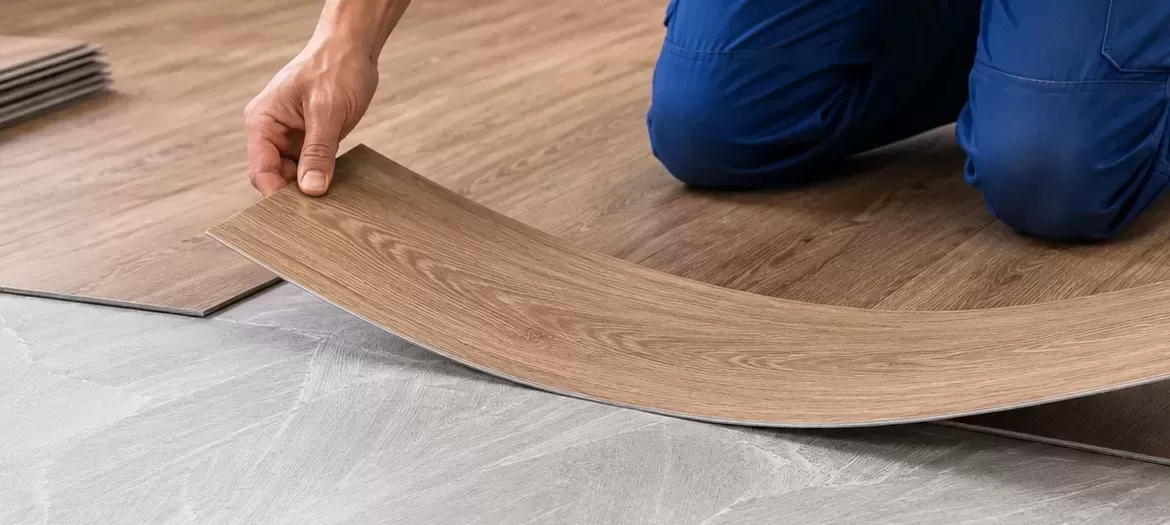
The long-term performance of bathroom sheet vinyl flooring relies heavily on correct installation procedures. Resilient flooring does not hide substrate imperfections; rather, it telegraphs them. Thus, preparation of the subfloor is the foundation of a successful installation.
First, the subfloor must be clean, flat, dry, and structurally sound. Any cracks or indentations must be filled with a high-strength, cementitious self-leveling compound. The flatness of the subfloor should meet a tolerance of 3mm over a 3-meter radius. Any debris, oil, or old adhesive residue must be mechanically removed to ensure proper adhesive bonding.
Second, material acclimation is required. The vinyl rolls and the specified adhesives should be stored in the installation space at a controlled temperature between 18°C and 25°C for at least 48 hours prior to installation. This process allows the vinyl to stabilize, preventing post-installation shrinkage or expansion.
Third, correct adhesive selection must be matching the substrate type and environmental conditions. For wet areas, a high-performance, water-resistant acrylic or polyurethane adhesive is recommended. The adhesive should be applied using the correct trowel notch size to ensure uniform transfer. After laying the sheet, the entire floor must be rolled with a heavy roller (typically 45kg to 68kg) in both directions to eliminate trapped air and secure a continuous bond.
Finally, flash covings should be implemented where the floor meets the wall. Instead of using a separate baseboard, the sheet vinyl is continued up the wall by 100mm to 150mm using a cove stick. This technique eliminates 90-degree corners at the wall-floor junction, creating a watertight basin that prevents water accumulation behind the walls and simplifies cleaning procedures.
Inquiry and Collaboration for Global Commercial Projects
Selecting and procuring commercial-grade resilient flooring involves analyzing chemical resistances, fire safety ratings, slip classifications, and mechanical tolerances. For large-scale projects, custom manufacturing ensures that the flooring meets local building codes and specific performance criteria without unnecessary expenditures.
TAB Flooring provides comprehensive technical support, material sample kits, and customized production runs for distributors, contractors, and architectural specifiers worldwide. Whether you are managing a multi-family housing development, a healthcare facility, or a hospitality renovation, our technical team is available to assist in drafting exact specifications and delivering compliant, high-durability solutions. Contact our commercial division to submit your project requirements, request a quotation, or receive physical samples for testing.
Frequently Asked Questions
Q1: Can bathroom sheet vinyl flooring be installed directly over existing ceramic tiles?
A1: Installation over existing tiles is possible, but it requires thorough preparation. The grout lines of the existing tile must be filled with a patch compound or a self-leveling underlayment to create a completely flat surface. Any loose or cracked tiles must be removed and repaired. If the subfloor is not properly smoothed, the pattern of the tiles will eventually telegraph through the new vinyl sheet, ruining the aesthetic and creating uneven wear points.
Q2: How does temperature variation in bathrooms affect the dimensional stability of sheet vinyl?
A2: Extreme temperature fluctuations can cause vinyl to expand and contract. To prevent bucking or gapping, modern sheet vinyl utilizes an embedded fiberglass reinforcement layer. This layer restricts movement, keeping the flooring flat. Proper acclimation of the material to the room temperature prior to installation and utilizing premium, temperature-stable adhesives further mitigate potential movement.
Q3: What slip resistance rating is recommended for public access commercial restrooms?
A3: For public commercial restrooms, a slip resistance rating of R10 under the DIN 51130 standard is recommended. In wet areas where users walk barefoot, such as public changing rooms or walk-in shower areas, a Class B or Class C rating under the DIN 51097 barefoot ramp test is specified to ensure adequate grip under wet conditions.
Q4: Why is a flash cove installation preferred over standard baseboards in wet rooms?
A4: Flash coving involves running the sheet vinyl up the wall by several inches. This method eliminates the joint between the floor and the wall, which is a common point for water pooling and mold growth. Flash coving creates an impervious barrier, preventing liquid from penetrating the wall cavity and facilitating easier cleaning and sanitization.
Q5: What is the difference between chemical welding and heat welding for sheet vinyl seams?
A5: Chemical welding uses a liquid cold-welding agent to melt the edges of the vinyl together, forming a continuous seam. This method is common in residential applications. Heat welding involves cutting a groove between the joints and melting a physical PVC welding rod into the groove using a hot-air gun. Heat welding provides a stronger, more reliable bond and is mandatory for commercial, healthcare, and high-moisture environments.