In commercial architecture, hospitality design, and multi-family housing development, wet-area surfacing requires meticulous planning. Traditionally, ceramic and porcelain tiles dominated these spaces due to their impervious nature. However, high material costs, prolonged installation timelines, and the vulnerability of grout lines to mold and moisture penetration have prompted a structural shift in the market. When selecting commercial-grade materials, architects and interior specifiers increasingly turn to bathroom vinyl flooring to replace traditional ceramic tiles.
Modern resilient floor coverings offer a balance of aesthetic versatility, rapid installation, and robust waterproof capabilities. Yet, not all resilient floors are engineered equally. Specifying the correct product requires a thorough understanding of polymer chemistry, core composition, wear layer performance, and subfloor integration. At TAB Flooring, we analyze these technical attributes to help procurement teams specify products that survive decades of daily wear.
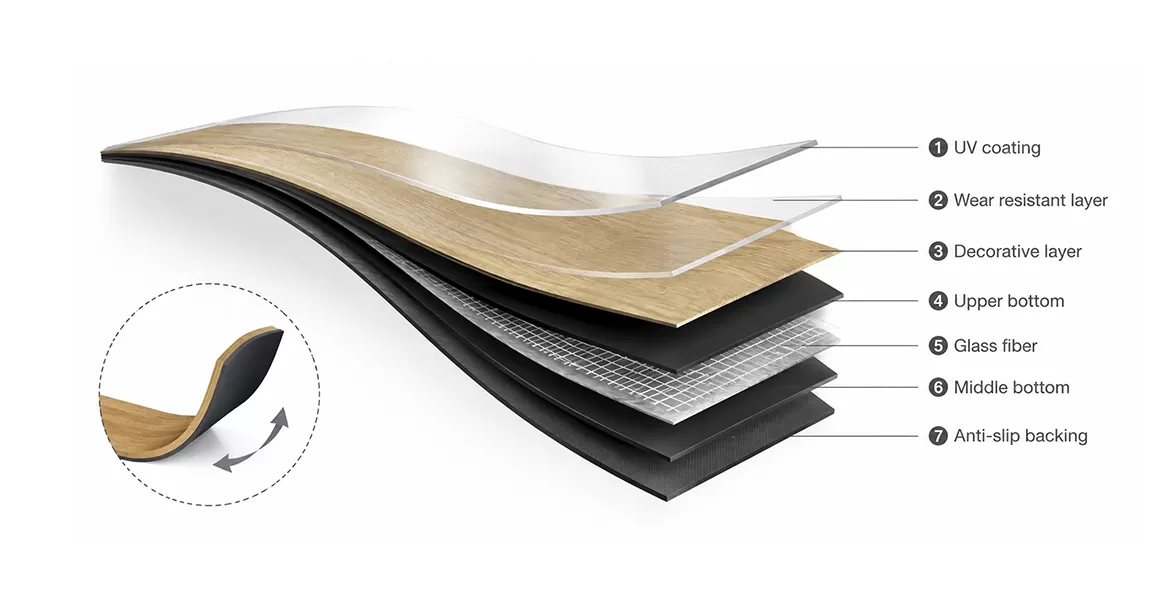
Evaluating the Physical Composition of Bathroom Vinyl Flooring
Resilient flooring covers a broad spectrum of product categories, from traditional sheet vinyl to advanced modular click systems. For commercial wet spaces, the choice generally narrows down to two primary structures: Luxury Vinyl Tile (LVT) and Stone Plastic Composite (SPC). Each presents distinct physical properties that dictate performance under moisture exposure, temperature fluctuations, and structural loads.
Stone Plastic Composite (SPC) Core Dynamics
SPC represents a significant advancement in rigid core technology. Composed of approximately 70% to 75% natural calcium carbonate (limestone) combined with polyvinyl chloride (PVC) stabilizers, the core is extruded under high heat and pressure without the use of foaming agents. This creates an extremely dense, rigid board that exhibits negligible dimensional movement.
Dimensional Stability: SPC typically exhibits less than 0.08% dimensional variation under thermal stress (tested under EN 434 / ASTM F2199). This is highly important in bathrooms where hot water exposure creates localized temperature spikes.
Indentation Resistance: The high density of the limestone-heavy core provides superior resistance to static loads, such as heavy porcelain fixtures or vanity units, preventing permanent indentations.
Waterproof Integrity: The inorganic composition ensures the core will not swell, warp, or delaminate when exposed to standing water, making it a reliable choice for wet environments.
Flexible and Semi-Rigid Luxury Vinyl Tile (LVT)
Traditional LVT consists of a higher ratio of PVC and plasticizers, resulting in a more pliable plank. While LVT is inherently waterproof, its flexible nature means it conforms to subfloor irregularities. In commercial bathrooms, flexible LVT is typically installed using a full-spread wet-set adhesive. This method creates a continuous bond with the concrete slab, reducing the risk of water migrating beneath the planks. However, because it lacks the rigid stone-composite core, LVT requires a highly flat subfloor to prevent telegraphing of subfloor defects to the surface.
Moisture Migration and Subfloor Protection Protocols
The primary point of failure in any wet-area flooring installation is not the material itself, but the migration of moisture beneath the surface. Water penetration leads to adhesive emulsification, subfloor degradation, mold cultivation, and eventual structural failure. For high-traffic commercial environments, modern bathroom vinyl flooring utilizing Stone Plastic Composite (SPC) offers superior indentation resistance compared to traditional luxury vinyl tile (LVT).
To mitigate these risks, architects must specify a comprehensive moisture management system. This involves addressing both hydrostatic pressure from the concrete slab below and topical water from daily usage above.
Concrete Slab Moisture Testing
Before installing any floor covering, the concrete subfloor must undergo rigorous testing to determine its Moisture Vapor Emission Rate (MVER) and relative humidity. The industry recognizes two primary testing standards:
ASTM F2170 (In-situ Relative Humidity): Measures the relative humidity within the concrete slab using specialized probes. For most commercial resilient installations, an RH level below 85% is acceptable, though specialized adhesives can accommodate up to 95% or 99% RH.
ASTM F1869 (Calcium Chloride Test): Measures the rate of water vapor emission from the surface of the slab over a 24-hour period. Rates exceeding 5 lbs. per 1,000 sq. ft. per 24 hours generally require a topical moisture mitigation barrier.
The multi-layer manufacturing process at TAB Flooring incorporates a high-density SPC core with a co-extruded wear layer, establishing a physical barrier against topical liquid penetration. When paired with a continuous polyurethane vapor barrier or a moisture-tolerant adhesive, this setup stops water from pooling under the flooring planks.
The Importance of Underlayment Chemistry
Integrated underlayment is standard in many premium resilient products. For bathroom environments, the chemistry of this underlayment is highly important. Specifiers must avoid open-cell foam underlayments, which behave like sponges, holding moisture and fostering mold growth. Instead, closed-cell structures like Irradiated Cross-Linked Polyethylene (IXPE) are preferred. IXPE is hydrophobic, resists compression over time, and offers excellent acoustic dampening (Impact Insulation Class - IIC ratings) without absorbing ambient moisture.
Slip Resistance and Safety Parameters in Wet Environments
Slip-and-fall incidents pose significant liability concerns in commercial and hospitality environments. Bathrooms, by nature, are subject to frequent spills of water, soap, and cosmetic oils. Consequently, the surface texture and coefficient of friction of the flooring material are paramount safety specifications.
Evaluating Slip Resistance Standards
Several testing methodologies are employed globally to quantify slip resistance. When evaluating resilient surfaces for bathrooms, specifiers should look for the following metrics:
DIN 51130 (Ramp Test): Classifies surfaces from R9 to R13 based on the angle of inclination at which a test subject slips while walking on an oil-coated surface. For public restrooms and commercial wet areas, a minimum rating of R10 is highly recommended.
DIN 51097 (Barefoot Wet Ramp Test): Specifically evaluates barefoot slip resistance using water as the contaminant. Surfaces are rated A, B, or C. For commercial showers and changing rooms, Class B or Class C performance is necessary to maintain traction.
ASTM C1028 / ANSI A326.3 (Dynamic Coefficient of Friction - DCOF): Standardizes testing in the North American market. For wet indoor level surfaces, a DCOF value of ≥ 0.42 is the baseline requirement for reducing slip potential.
Surface Texturing and Embossing-in-Register (EIR)
To achieve these slip-resistance ratings without compromising cleaning protocols, manufacturers utilize advanced texturing techniques. Embossing-in-Register (EIR) aligns the physical surface texture of the wear layer with the underlying high-definition visual film. This creates realistic wood grain or stone textures that provide mechanical traction underfoot. However, the depth of the texture must be carefully calibrated; overly deep grooves can trap dirt, soap scum, and oils, making mechanical maintenance difficult for facility cleaning crews.
Wear Layer Thickness and Chemical Resistance
The durability of resilient flooring is directly proportional to the thickness and composition of its wear layer. In commercial bathrooms, the floor must withstand not only foot traffic but also exposure to harsh sanitizing chemicals, cosmetic reagents, and bodily fluids.
| Application Class | Wear Layer Thickness (mil / mm) | Core Type Recommended | Typical Environment |
|---|---|---|---|
| Light Commercial | 12 mil / 0.3 mm | LVT / SPC | Boutique Hotel Bathrooms, Executive Restrooms |
| General Commercial | 20 mil / 0.5 mm | SPC (Rigid Core) | Multi-Family Residential, Hotel Guestrooms |
| Heavy Commercial | 22 mil / 0.55 mm+ | SPC or Glue-down LVT | Public Restrooms, Healthcare Facilities, Gyms |
To further protect the wear layer, high-performance resilient floors are treated with a factory-applied UV-cured polyurethane coating reinforced with ceramic beads or aluminum oxide particles. This top coat provides several vital performance characteristics:
Micro-Scratch Resistance: Prevents the fine abrasions caused by tracked-in dirt and sand, which can dull the gloss level of the floor over time.
Stain Defiance: Resists chemical penetration from common bathroom agents such as hair dyes, isopropyl alcohol, hand sanitizers, and acidic cleaners.
Antimicrobial Properties: Many modern coatings incorporate silver-ion technology or other EPA-registered antimicrobial additives that inhibit the growth of bacteria and fungi on the flooring surface.
Installation Protocols: Ensuring Long-Term Waterproof Seals
Even the highest-spec product will fail if the installation method does not account for the realities of wet-area dynamics. When installing bathroom vinyl flooring, specific precautions must be taken at the perimeter and around plumbing penetrations.
Adhesive Selection for Commercial Bathrooms
For modular click-lock SPC systems, the floor is installed as a floating system, allowing for natural expansion and contraction. However, in commercial bathrooms, a floating installation requires strict perimeter sealing. For direct glue-down LVT, the adhesive chemistry is vital. Specifiers should mandate a high-solids, moisture-resistant acrylic or reactive polyurethane adhesive. Water-soluble adhesives can emulsify if water seeps through the seams, causing bond failure and curling of the plank edges.
Perimeter Sealing and Flashing
To prevent water from migrating behind the baseboards and beneath the resilient planks, the following detailing steps are recommended during installation:
Expansion Gap Maintenance: A 1/4-inch (approx. 6mm) expansion gap must be left around the entire perimeter, including pipes, vanity legs, and door frames.
100% Silicone Sealant: Before installing trim or baseboards, the expansion gap in wet areas must be filled with a high-grade, 100% silicone wet-area sealant. This remains flexible while forming a watertight barrier.
Toilet Flange Coordination: The flooring must not be installed beneath toilet flanges. Instead, cut the planks to fit around the collar, apply a continuous bead of silicone, and mount the toilet fixture directly to the subfloor through the specified mounting points.
Addressing Common Industry Pain Points
Procurement managers and general contractors often voice concerns regarding resilient flooring failures. Understanding these pain points allows specifiers to address them proactively during the design phase.
Telegraphing of Subfloor Imperfections
Telegraphing occurs when the uneven texture of a concrete slab, trowel marks, or screw heads in underlayment plywood show through to the surface of the finished floor. While this is a common issue with flexible glue-down LVT, it is largely eliminated by specifying a high-density, rigid core SPC. The rigid construction bridges minor subfloor imperfections, ensuring a flat, uniform surface visual.
Joint Separation and Water Seepage
Under heavy foot traffic or rolling loads (such as laundry carts in hotels), weak click-lock joints can shear or separate, opening a direct pathway for water. To prevent this, specifiers should check that the product features a patented, high-tensile locking system (such as Uniclic or Välinge profiles) extruded directly into the core. These systems provide high horizontal and vertical locking strength, keeping the planks tightly joined even under dynamic loads.
Frequently Asked Questions
Q1: Is bathroom vinyl flooring suitable for commercial wet rooms with
open floor drains?
A1: Generally, modular SPC click flooring is not
recommended for wet rooms with open floor drains or continuous standing water,
such as open commercial showers. In these specific environments, heat-welded
sheet vinyl with a flashed cove base is the industry standard to ensure a
continuous, monolithic waterproof membrane.
Q2: How does temperature variation in commercial bathrooms affect
resilient flooring?
A2: Temperature fluctuations from hot showers
can cause standard LVT to expand and contract. To prevent bucking or joint
separation, specifying a stone plastic composite (SPC) core is recommended, as
its mineral-heavy composition remains dimensionally stable across a wide
temperature spectrum.
Q3: Can bathroom vinyl flooring be installed over existing ceramic
tiles?
A3: Yes, high-density SPC rigid core flooring can be
installed directly over existing flat ceramic tiles, provided the grout joints
are filled with a Portland cement-based patching compound to create a flat
substrate. This eliminates demolition costs and shortens renovation
schedules.
Q4: What is the recommended wear layer for high-use public
restrooms?
A4: For high-traffic public restrooms in airports,
shopping centers, or office towers, a minimum wear layer thickness of 22 mil
(0.55 mm) with a reinforced UV-cured polyurethane surface coating is recommended
to ensure long-term resistance to heavy foot traffic and frequent cleaning.
Q5: Does vinyl flooring support commercial underfloor heating
systems?
A5: Yes, most premium resilient and SPC products are
compatible with hydronic or electric radiant underfloor heating systems.
However, the system temperature must be regulated to not exceed 85°F (29°C) to
prevent adhesive degradation and thermal stress on the vinyl planks.
Project Specification and Architectural Collaboration
Selecting the ideal surface material for commercial wet areas requires balancing installation speed, cost-efficiency, safety, and long-term durability. By understanding the mechanical differences between SPC and LVT, evaluating wear layer performance, and implementing strict subfloor moisture mitigation protocols, specifiers can deliver highly durable, low-maintenance spaces that withstand demanding operational conditions.
As a contract manufacturer, TAB Flooring specializes in supplying high-performance bathroom vinyl flooring tailored to your exact architectural requirements. We provide comprehensive technical documentation, including ASTM test reports for slip resistance, sound transmission, and dimensional stability, helping your project meet structural codes and environmental standards. Contact the technical support team at TAB Flooring to request physical samples, ASTM test reports, or custom aesthetic designs for your next commercial project.