In commercial architecture and contract interior design, the demand for classic geometric patterns has experienced a significant resurgence. Historically, incorporating intricate layouts like herringbone required utilizing expensive solid hardwood or highly fragile ceramic tiles. Modern polymer chemistry and manufacturing advancements have transformed this sector, allowing specifiers to select herringbone vinyl flooring as a durable, cost-effective, and moisture-resistant alternative that retains the sophisticated aesthetic of traditional parquet.
For B2B importers, distributors, and commercial contractors, sourcing the correct specification of herringbone vinyl flooring involves evaluating complex structural properties, click profile mechanics, and supply chain logistics. This analysis explores the structural attributes, common installation challenges, and production parameters that procurement professionals must analyze when selecting resilient floor coverings for large-scale projects.
The Structural Architecture of Resilient Parquet
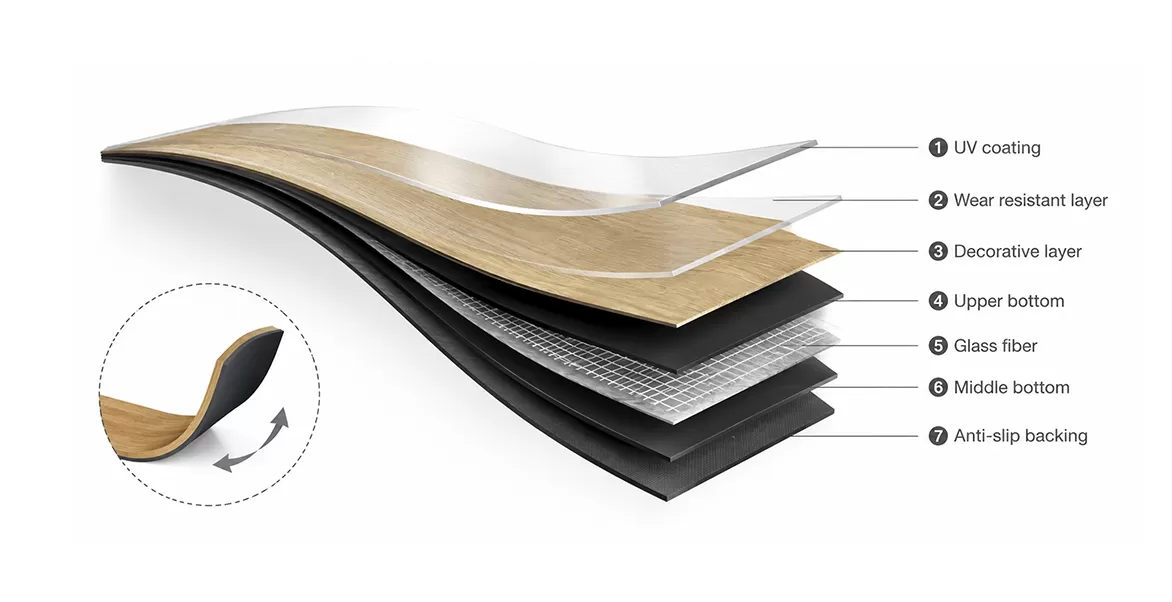
Standard plank flooring allows for minor variations in dimensional stability because the linear layout absorbs micro-movements across a singular axis. In contrast, herringbone patterns feature planks intersecting at 90-degree angles. This interlocking geometry means that any dimensional expansion or contraction is compounded across both width and length, making material composition a fundamental factor in product selection.
When selecting herringbone vinyl flooring, specifiers generally choose between two primary product classes: Stone Plastic Composite (SPC) and Luxury Vinyl Tile (LVT) Dryback.
Stone Plastic Composite (SPC) Herringbone
SPC represents the rigid core segment of resilient flooring. Composed of approximately 60% to 70% calcium carbonate (limestone) blended with polyvinyl chloride and stabilizers, SPC offers high dimensional stability. The high density of the core provides exceptional resistance to residual indentation from heavy furniture and rolling loads, making it suitable for commercial offices and retail spaces.
Dryback Luxury Vinyl Tile (LVT) Herringbone
Flexible LVT designed for glue-down application remains a highly reliable choice for high-traffic environments. Because the material is bonded directly to the subfloor with commercial-grade adhesives, the risk of joint separation or shifting is minimized. However, dryback installation requires extensive subfloor preparation, as any subfloor imperfections will telegraph through the thinner vinyl profile.
The table below outlines the primary performance differences between these two options:
| Performance Metric | SPC Rigid Core Herringbone | Glue-Down LVT Herringbone |
|---|---|---|
| Dimensional Stability | High (due to limestone core) | Moderate (relies on adhesive bond) |
| Subfloor Requirements | Can bridge minor subfloor irregularities | Requires flat, self-leveling underlayment |
| Acoustic Performance | Excellent when paired with attached pad (IXPE) | Moderate (requires specialized acoustic adhesive) |
| Replacement Protocol | Requires unclicking back to the wall interface | Individual plank removal and re-gluing |
The Mechanics of Click-Lock Herringbone Systems: A and B Planks
A primary point of differentiation between standard linear flooring and herringbone vinyl flooring is the milling of the click-lock profiles. Linear planks utilize a single profile configuration where the tongue on one side inserts into the groove of the adjacent plank. A herringbone pattern requires two distinct types of planks, commonly referred to as Plank A and Plank B.
These planks are mirrored images of each other. On Plank A, the tongue profile is milled on the right-hand long edge, while on Plank B, the tongue is milled on the left-hand long edge. During installation, installers must alternate these planks systematically to construct the interlocking V-shape pattern.
This requirement introduces several logistical and operational considerations for B2B buyers:
Packaging Precision: Manufacturers must pack A and B planks in equal quantities within each carton, or clearly label distinct cartons as "Plank A" and "Plank B" to prevent installation delays.
Milling Tolerances: Because the planks intersect at right angles, the profiling machinery must maintain tolerances within 0.05 millimeters. Minor deviations in the click system will cause cumulative gapping, which becomes highly visible after installing several rows.
Profiling Technologies: Patented locking systems such as Välinge (5G or 5G-i) or Uniclic are often preferred for herringbone patterns. These profiles allow for secure, drop-down locking on the short ends, reducing installation time and post-installation joint failures.
Procurement Pain Points and Supply Chain Solutions
Procuring large quantities of resilient flooring for commercial projects involves addressing specific manufacturing and logistical challenges. Identifying these issues early in the specification stage helps prevent costly project delays.
Managing the Waste Factor in Geometric Layouts
Standard parallel plank installations typically require a 5% to 7% waste allocation for cutting and trimming. Herringbone patterns, because of the diagonal orientation of the planks relative to the walls, demand a higher waste factor, usually between 10% and 15%. This percentage can increase in irregular spaces with numerous columns or alcoves. B2B buyers must calculate these requirements accurately during the initial ordering phase to avoid shortfalls, as subsequent production runs may exhibit slight color variations.
Color Consistency and Batch Control
Large commercial projects requiring thousands of square meters of material are often supplied from multiple production runs. Resilient flooring utilizes printed decor films protected by a wear layer. Slight shifts in print temperature, ink viscosity, or wear layer extrusion can create visible tone variations between batches. Professional manufacturers, including TAB Flooring, address this by utilizing advanced spectrophotometer testing during production to verify that all batches fall within acceptable Delta E thresholds.
To maintain consistent visual continuity across large surfaces, suppliers should implement strict batch-tracking protocols. This involves marking every crate with corresponding batch numbers and ensuring that material from the same production run is installed in contiguous areas.
Application Suitability in Commercial Sectors
Selecting the correct specification of herringbone vinyl flooring requires aligning the material's properties with the physical demands of the target environment.
Hospitality and Multi-Family Housing
In hotels, apartments, and condominiums, acoustic control is a key design requirement. SPC herringbone flooring specified with an integrated IXPE (Irradiated Cross-linked Polyethylene) or cork underlayment helps mitigate impact sound transmission between floors. Additionally, the wear layer thickness should be specified at a minimum of 0.55mm (22 mil) to withstand constant foot traffic and luggage movement in corridors and lobbies.
Retail and Showroom Spaces
Retail environments experience high point loads and rolling traffic from shopping carts or displays. A high-density rigid core SPC herringbone provides the necessary indentation resistance. Incorporating a high-performance polyurethane (PU) coating with ceramic bead technology protects the decor layer from scuffing, maintaining the pattern's visual appeal over its service life.
Corporate Office Environments
Modern workplaces prioritize both design aesthetics and cleanability. Herringbone vinyl flooring offers a premium look while remaining compatible with underfloor power distribution systems. Specifying low-VOC certified products (such as FloorScore or Blue Angel) ensures that the flooring contributes to healthy indoor air quality, supporting green building certifications like LEED or WELL.
Quality Control Measures at TAB Flooring
As a dedicated partner in the global resilient flooring sector, TAB Flooring focuses on manufacturing standards that address the challenges of herringbone patterns. Our production facilities utilize precision profiling equipment to ensure that the A and B interlocking systems align consistently during installation.
Our quality control protocol includes verifying dimensional stability through thermal exposure testing, measuring wear layer thickness uniformity, and monitoring locking strength. By managing these variables, we provide B2B clients with reliable flooring solutions that perform well under demanding commercial conditions.
Frequently Asked Questions
Q1: Why is the waste factor higher for herringbone vinyl flooring compared to standard linear planks?
A1: The diagonal orientation of the herringbone pattern relative to the perimeter walls requires cutting planks at 45-degree angles at the borders of the room. This process generates more triangular waste pieces that cannot be utilized elsewhere in the installation, requiring a 10% to 15% waste allowance depending on the layout of the space.
Q2: Can SPC herringbone flooring be installed over existing ceramic tile?
A2: Yes, rigid core SPC herringbone can be installed over ceramic tile, provided the grout joints are less than 5mm wide and 3mm deep. Wider or deeper grout lines should be filled with a self-leveling compound to prevent telegraphing and to ensure a stable subfloor for the click-lock system.
Q3: What is the purpose of A and B planks in a herringbone layout?
A3: To create the intersecting V-pattern of a herringbone design, the tongue and groove profiles must be mirrored on alternating planks. If only a single plank configuration were used, the locking joints would not align at the 90-degree intersections. Planks are divided into A and B configurations to ensure the joints interlock properly.
Q4: How does wear layer thickness impact the lifespan of herringbone flooring in commercial environments?
A4: The wear layer is the clear protective coating above the printed design film. For light commercial spaces, a 0.3mm (12 mil) wear layer is typically sufficient, whereas heavy commercial environments require a 0.55mm (22 mil) or 0.7mm (28 mil) wear layer to protect against abrasive wear and maintain the appearance of the pattern over time.
Q5: What is the optimal subfloor preparation for glue-down LVT herringbone flooring?
A5: Glue-down LVT requires a flat, dry, and clean subfloor. Concrete substrates must be cured and tested for moisture emission levels. Any irregularities, cracks, or texture must be addressed using a premium patching or self-leveling cementitious underlayment to prevent imperfections from showing through the finished flooring.
Q6: How do temperature fluctuations affect installed SPC herringbone floors?
A6: SPC floors feature high dimensional stability due to their limestone-rich core, expanding and contracting less than traditional luxury vinyl. However, extreme temperature shifts can still cause minor movement. Providing proper expansion gaps around the perimeter of the room allows the floating floor to adjust naturally without buckling or separating at the joints.
Commercial Inquiry and Project Support
Selecting the appropriate flooring specification is critical to the longevity and performance of your commercial interior projects. Our team at TAB Flooring provides comprehensive support to distributors, contractors, and design professionals worldwide. To request technical datasheets, physical product samples, or a detailed quotation for your upcoming project, please contact our commercial sales division.